Nippon Dynawave faces roughly $10.1 million in Washington penalties and response costs after the chemical tank failure that killed 11 workers at its Longview paper mill in May. The state announced the actions on Nov. 20; the company says the workplace-safety findings omit important context and plans to challenge them.
The largest part is a $9,177,127 workplace-safety fine. Separate environmental penalties and reimbursement account for about $961,000. Those amounts pay different obligations, and the company's appeal rights run on a timetable tied to receipt of the citation.
What the $10.1 million covers
The Labor & Industries citation lists 75 workplace-safety violations. The agency calls the assessment Washington's largest safety and health fine, exceeding the $2.9 million penalty following the 2010 Tesoro refinery explosion.
Ecology's Nov. 20 enforcement packet separates its charges into $141,000 for water-quality violations, $7,500 for air-quality violations and $148,000 for dangerous-waste violations. Those penalties total $296,500.
An additional $664,776.77 reimburses the state's response expenses. Ecology's public enforcement page gives that exact figure; the joint announcement rounds the reimbursement to $665,000. Combining the exact reimbursement with both agencies' penalties produces $10,138,403.77.
The joint announcement instead gives a combined $10,138,127. The underlying figures do not reconcile to that total. The published combined figure is $276.77 below the sum of the itemized amounts.
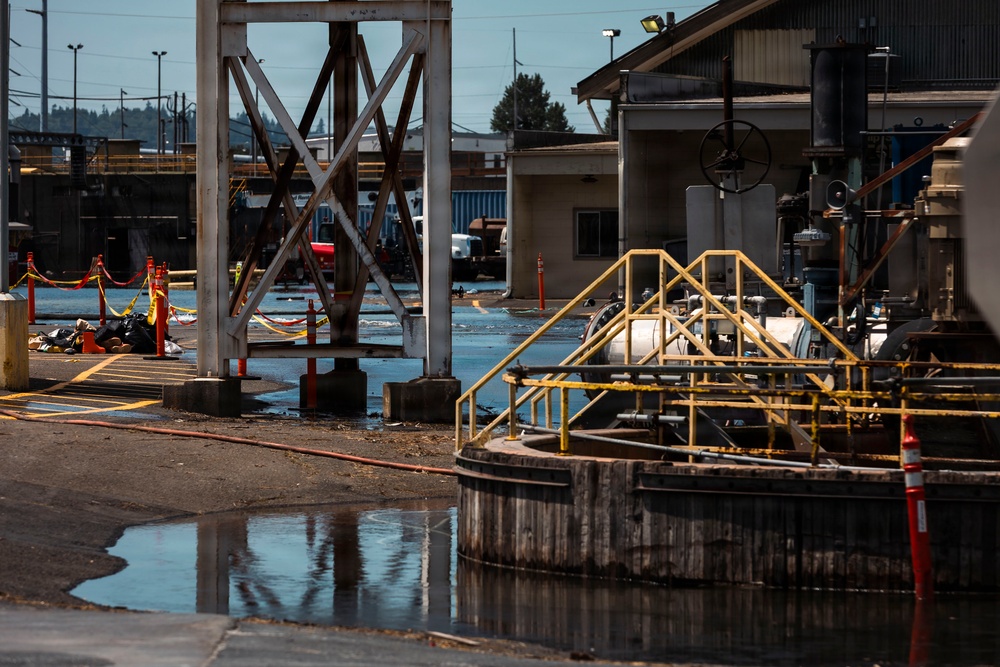
Ecology says spilled white liquor entered storm drains and wastewater systems, with some reaching the Columbia River without treatment. Its penalty notice records eight days of discharge through an outfall into a nearby ditch. Responders collected 2,902 dead fish from the ditch system and surrounding area.
What investigators say went wrong
L&I's investigation summary describes repeated warnings about thinning steel walls in G-tank. Inspectors tested the tank in July and October 2025 and February 2026. The agency says managers received the first report in August 2025 but continued operating the tank without making it safe.
Forty-three violations correspond to the weeks the tank remained in service after that report. Other citations concern inspections of additional tanks and emergency planning, training and command.
The report describes three options when corrosion leaves a tank below its minimum safe thickness: repair it, restrict how much liquid it holds or take it out of service. L&I says the company discussed those choices but prioritized other projects.
A separate Chemical Safety Board update in August explained the process: the tank stored white liquor used to break down wood into pulp. The liquid was about 200 degrees Fahrenheit and highly corrosive. Approximately 900,000 gallons escaped when the tank failed.
The federal board investigates causes and makes recommendations. It does not issue citations or fines.
What the company disputes
In its Nov. 20 response, Nippon Dynawave said L&I's characterization of its actions failed to include important facts and context about the company's conduct and the timeline. It said it would address that through the appeals process.
The company is separately reviewing Ecology's penalty and reimbursement request before deciding its next steps. It also argues that workplace-safety findings should be distinguished from a completed root-cause investigation, which it says remains unfinished.
L&I has reached its own conclusion that pressure inside the tank exceeded the strength of its thinning walls.
Appeals, corrections and worker benefits
Nippon Dynawave has 15 working days after receiving the L&I citation to appeal. The citation defines working days as excluding Saturdays, Sundays and legal state holidays. That is not a 15-calendar-day deadline starting with Friday's public announcement.
Under L&I's appeal procedures, an appeal does not automatically suspend the duty to correct a cited hazard. An employer can request a stay of the correction deadline.
L&I says it will refer the case for possible criminal prosecution. That announcement describes a referral for consideration, not a criminal conviction.
Money collected from workplace-safety fines goes to the state's workers' compensation supplemental pension fund. Families and injured workers have a separate benefits and assistance process, including wage replacement, medical care and survivor claims.