
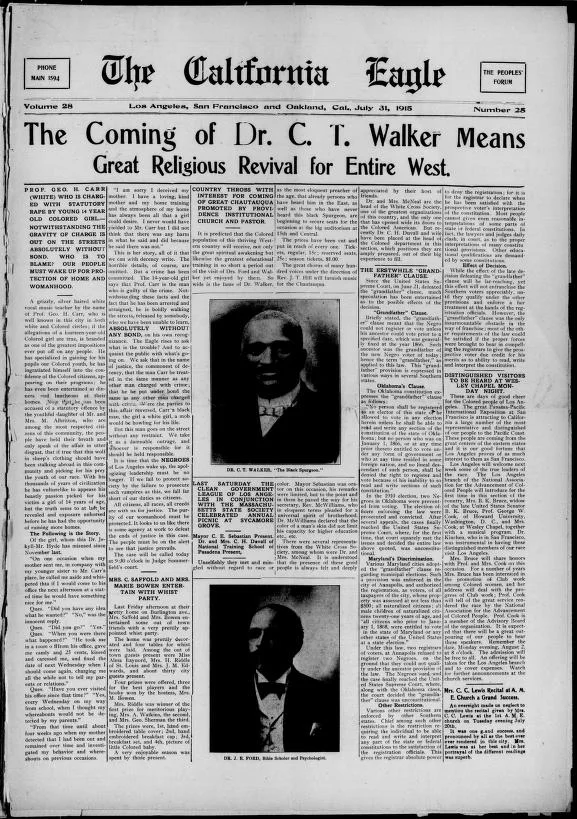
A Supreme Court voting-rights explainer, a visiting preacher and a whist party shared the California Eagle's front page on July 31, 1915. Inside, Pasadena readers could find church services, news of neighbors traveling north and advertisements for a tailor, a plumber and a print shop. The paper covered the national struggle for equal rights and the daily business of a Black community.
More of that record is now available online. The Library of Congress announced November 27 that it has added California Eagle issues dating from 1913 through 1963 to Chronicling America. The addition expands access announced in May. It is not the newspaper's first appearance online, and the announcement does not identify every newly added issue or promise an unbroken run.
Voting rights on the front page
The July 31 issue offers a way into the paper's range. Its largest headline promoted the coming of the Rev. C. T. Walker and a religious gathering. Farther down, an article explained the Supreme Court's recent decisions against discriminatory voting provisions in Oklahoma and Maryland.
The Oklahoma provision tied an exemption from a literacy requirement to whether a person, or an ancestor, had been entitled to vote on or before January 1, 1866. That date reached back before the Fifteenth Amendment prohibited denying the vote on racial grounds. In Guinn v. United States, decided June 21, 1915, the Court held the state's grandfather clause unconstitutional.
The Eagle printed the provision and traced the litigation for readers in California. It brought a constitutional dispute from elsewhere in the country onto the same page as neighborhood news.
The religious gathering advertised regular tickets at 15 cents, reserved seats at 25 cents and season tickets at $1. It named a chorus director and gave the auditorium location at 15th and Central. Alongside those stories, the paper described an afternoon whist party, named visiting guests and listed the prizes. News of civic organizations and religious events occupied the same front page as its arguments about justice.
Pasadena's news and businesses
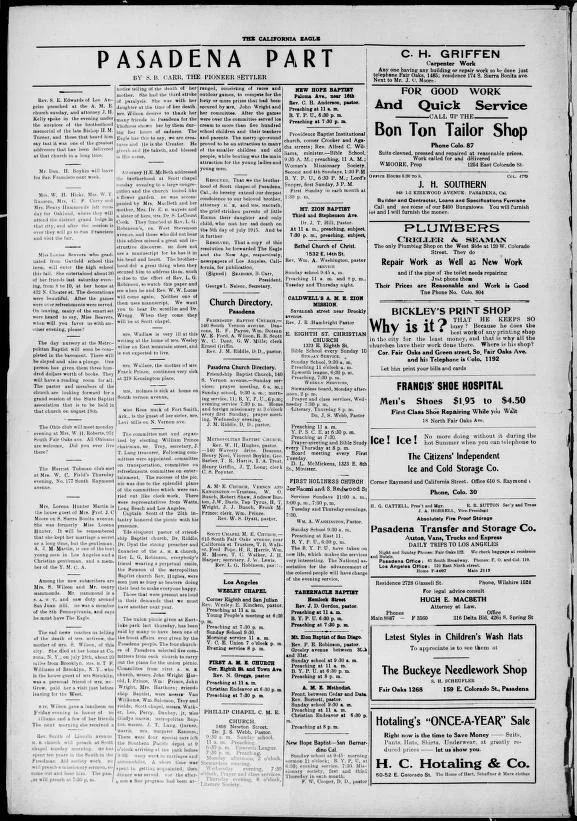
The second page has a section called "Pasadena Part," credited to S. B. Carr. It follows people leaving for Oakland and San Francisco, reports a school graduate's party and records a meeting of the Harriet Tubman club. A church nursery and reading room appear among the neighborhood's plans.
The page also reports a union picnic organized by four Pasadena churches. Its account describes special cars leaving the Southern Pacific depot, outdoor games and ice cream served to schoolchildren and their families. Residents of Watts, Long Beach and Los Angeles joined the gathering, according to the paper.
Advertisements share the page with that social record. A tailor offers cleaning and repairs. A print shop solicits bills and cards. A lawyer advertises legal advice, while a transfer and storage company lists daily trips to Los Angeles. The church directory supplies addresses, pastors and service times across several cities.
Those details make the archive useful beyond the history of prominent leaders. Family names, clubs, businesses and street addresses appear together, with enough surrounding information to place a person within a neighborhood's institutions. The small notices record connections that a biography of the publisher alone would miss.
Charlotta Bass's newspaper
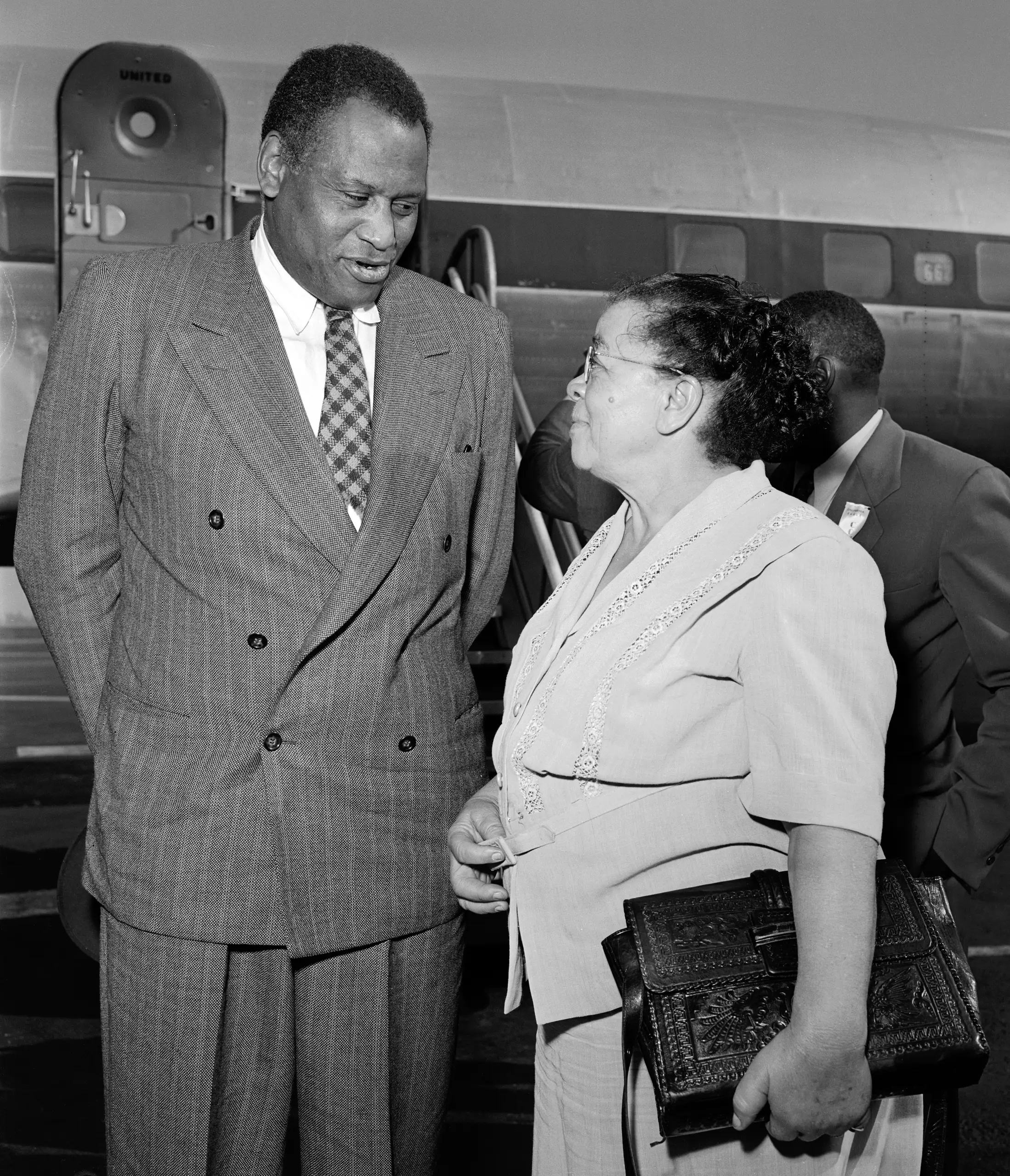
Charlotta Spears Bass took over the Eagle after founder John J. Neimore died in 1912. She had worked selling advertising for the Black-owned Providence Watchman before moving to California in 1910, according to the National Park Service.
Bass hired journalist Joseph Blackburn Bass as editor, and they later married. She remained publisher until 1951. Their newspaper challenged restrictive housing practices, police brutality and the Ku Klux Klan. By the 1930s, its circulation was nearly 60,000, the Park Service says.
The National Women's History Museum describes a publisher who also organized boycotts and challenged housing covenants. Bass helped start the Home Owners Protective Association in 1945. Her newspaper's campaigns addressed employment discrimination and the racist portrayal of Black people in D. W. Griffith's 1915 film The Birth of a Nation.
Her political work continued after she sold the paper in 1951. In 1952, she became the first Black woman nominated for vice president of the United States, running with Vincent Hallinan on the Progressive Party ticket.
Reading the expanded collection
The newspaper's catalog record dates its publication from 1879 to 1966. The additional material announced this month covers only part of that history. The July 1915 pages discussed here illustrate the collection; the announcement does not establish which upload batch contained them.
The Library's viewer pairs page images with searchable text and offers downloads. The scanned page remains useful when the text recognition breaks a name or misreads a letter. For reuse, the Library says U.S. newspapers published more than 95 years ago are in the public domain in their entirety. Its notice cautions that more recent issues may contain copyrighted third-party material. That distinction applies to an expansion whose dates reach into the 1960s.