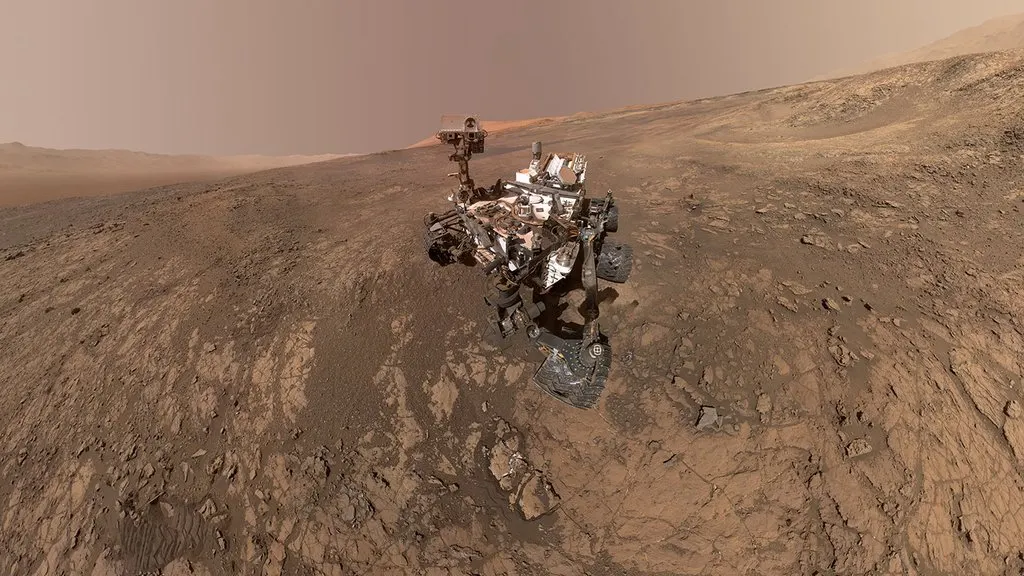
Curiosity's selfie at Vera Rubin Ridge is a panorama with a carefully explained construction. In its October 3 Astronomy Picture of the Day feature, NASA revisited a view assembled from 61 exposures taken by the rover's Mars Hand Lens Imager.
The pictures containing the camera arm were removed from the finished mosaic. That accounts for the apparently impossible viewpoint. There was no second photographer standing on Mars.
The central selfie was taken on mission sol 1943, corresponding to January 23, 2018 on Earth. NASA says the extended background used Mastcam material from sol 1903. October 3, 2026 is the date of the APOD feature, not the date the rover took a new selfie.
A mosaic can bring together details that would be difficult to capture in a single frame, while still requiring a clear account of which exposures were used. The construction is part of the image's meaning.
The components of the picture
| Component | NASA's description |
|---|---|
| Central selfie | MAHLI exposures from sol 1943, January 23, 2018 |
| Extended background | Mastcam material from sol 1903 |
| Camera arm | Arm-containing exposures omitted from the finished mosaic |
The ridge, Mount Sharp and Gale Crater
JPL's January 31, 2018 account identifies the ridge location, the distant rim of Gale Crater and Mount Sharp behind the rover's mast. That contemporary report helps separate where the rover stood from the later panoramic presentation. The later APOD caption explains the additional material used to extend the background.
The word panorama can conceal a time difference. Here the central selfie belongs to sol 1943 and the expanded background to sol 1903, forty Martian days earlier. The finished panorama combines those two observing dates, so it does not show the entire scene at a single instant.
Open the linked NASA feature for the panorama and its interactive-view link. When sharing it, retain the original capture date and the credits. A cropped screenshot labeled simply “Mars today” would lose the most useful explanation of what the picture actually shows.
A close-up camera makes a wide portrait
MAHLI's name describes its regular job. NASA's instrument account explains that the camera makes high-resolution close views of rocks and soil. It can focus from about 0.8 inch, or 2.1 centimeters, to infinity. A camera designed for details near the ground can therefore also photograph the rover and distant scenery.
The camera sits on the arm, so moving the arm changes the camera's position as well as its direction. Across a sequence, one view can supply terrain hidden by equipment in another. Joining selected portions explains how the vehicle can appear complete while the support holding its camera disappears. The finished viewpoint belongs to the assembled image rather than to a person standing a few feet away.
A conventional panorama made from a fixed tripod and this arm-mounted self-portrait solve different photographic problems. The tripod camera turns through the view. Curiosity must photograph a machine that includes the arm carrying the camera. The arm's movement and the choice of portions used in the mosaic are therefore essential to the picture.
Which version is on this page?
The cover here is the January 2018 mission mosaic credited to NASA/JPL-Caltech/MSSS. APOD's linked presentation includes the extended background and separately credits panorama maker Andrew Bodrov. Those presentations share source photography but need their own captions and credits. The 360-degree link is a way to explore the expanded presentation, not evidence that the cover is itself an interactive file.
JPL's 2018 report describes the layered slopes of lower Mount Sharp as deposits formed in the presence of water, probably in a lake or lakes within Gale Crater. That makes the background part of the scientific setting: the rover is working among layers accumulated over long periods. The absence of the arm is a construction detail; the ridge and slopes explain why the rover was there.