
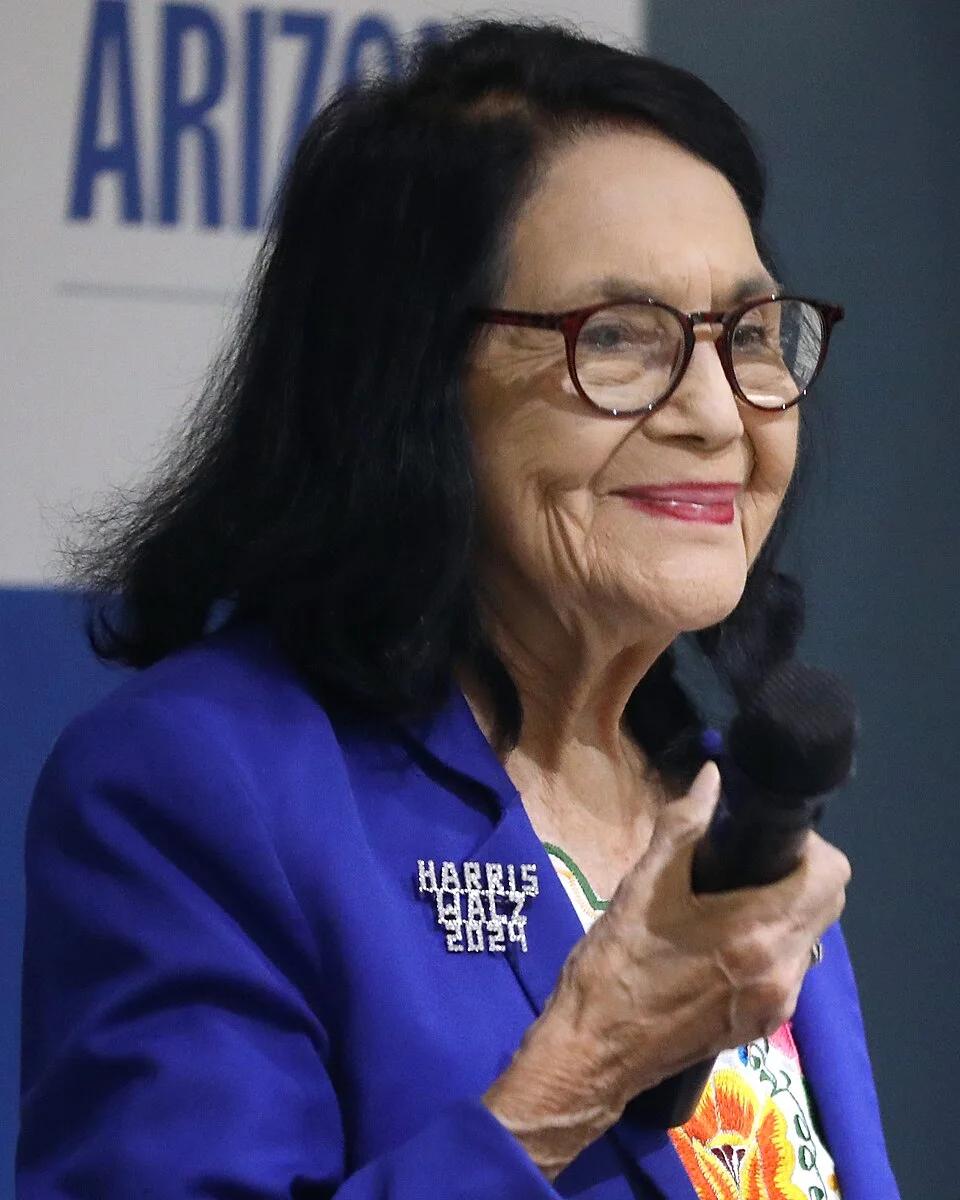
Dolores Huerta, who helped build the United Farm Workers and gave the farmworker movement its rallying cry, "Sí, se puede," died Wednesday, October 28, at her home in Bakersfield, California, surrounded by close family. She was 96. The Dolores Huerta Foundation announced her death with a statement from her family, who asked for privacy and said they would share plans to celebrate her life.
From a Stockton classroom to the grape boycott
Huerta was born April 10, 1930, in Dawson, a small mining town in New Mexico, and grew up in California's Central Valley, according to the proclamation Gov. Gavin Newsom issued for Dolores Huerta Day this April. She started out as a teacher in Stockton. Her students came to class hungry because their parents worked the fields for poverty wages, and she decided she could help them more by organizing the parents.
She registered voters with the Community Service Organization and by the late 1950s was lobbying in Sacramento, one of very few women doing that work. In 1962 she co-founded the National Farm Workers Association with Cesar Chavez. It merged in 1966 with the Filipino-led Agricultural Workers Organizing Committee of Larry Itliong and Philip Vera Cruz, whose members had walked out of the Delano vineyards in September 1965. The merged group became the United Farm Workers.
During the Delano strike and the national grape boycott, Huerta helped persuade consumers, churches and other unions to take sides. The foundation credits the boycott with getting 17 million people to stop buying grapes. It led to the first farmworker union contracts, and Huerta, one of the union's leading negotiators, sat across from growers to win gains in wages, health care, retirement and job safety. Her lobbying helped pass California's Agricultural Labor Relations Act in 1975, which gave farmworkers the right to organize and bargain collectively.
The organizing put her in danger. She was arrested, and in 1988 a San Francisco police officer severely injured her at a demonstration.
Women in office, immigration and the foundation
In the 1980s she joined a national campaign to elect more women, recruiting and campaigning for Latina candidates in particular. She also fought for the 1986 immigration law that gave legal status to millions of undocumented people, hundreds of thousands of them farmworkers, and against California's Proposition 187.
In 2003 she returned to the Central Valley and started the Dolores Huerta Foundation with her daughters Camila Chavez, Lori de Leon and Alicia Huerta. It trains residents of farmworker communities in the southern San Joaquin Valley to organize for better schools, cleaner water and civil rights. The foundation plans to open a Dolores Huerta Peace and Justice Cultural Center in the Central Valley in 2027.
In March 2026, Huerta disclosed that Chavez had sexually assaulted her in the 1960s. Her foundation says she spoke after other survivors came forward and had kept the secret for decades out of fear it would damage the movement.
Honors
In 1993 Huerta became the first Latina inducted into the National Women's Hall of Fame. She received the Eleanor Roosevelt Human Rights Award from President Bill Clinton in 1998 and the Presidential Medal of Freedom from President Barack Obama in 2012, and she entered the California Hall of Fame in 2013. At least 11 schools in the United States carry her name.
She is survived by 14 children, 24 grandchildren, 23 great-grandchildren and seven great-great-grandchildren. The family asked that people give to the Dolores Huerta Foundation instead of sending flowers or gifts.


