
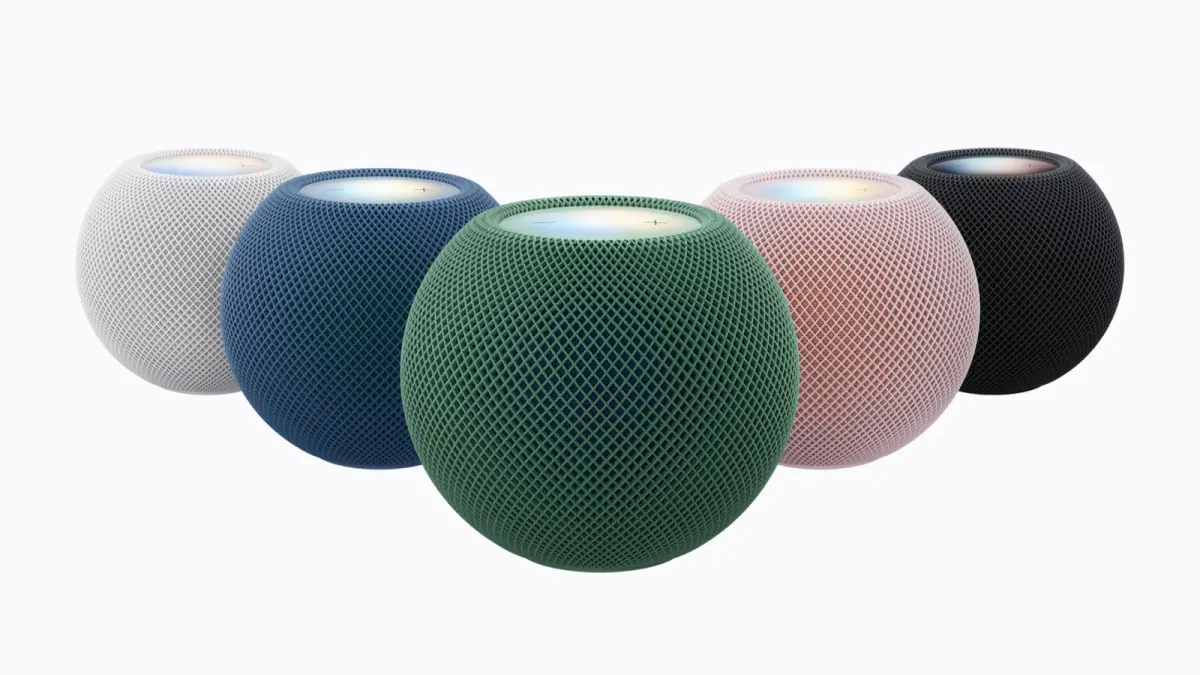
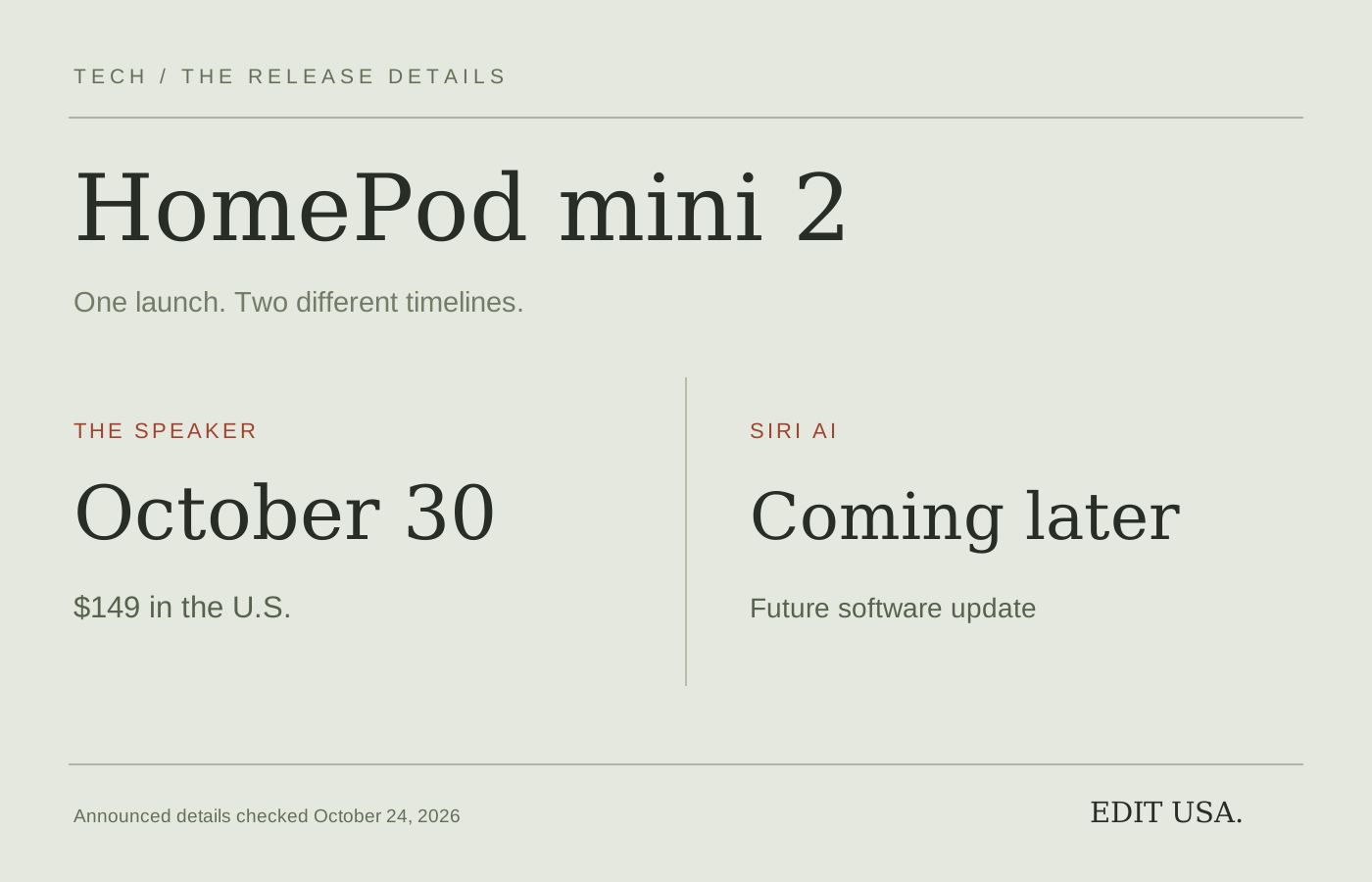
Apple’s HomePod mini 2 is due in stores on Friday, October 30, priced at $149 in the United States. Siri AI, one of the features in Apple’s October 13 announcement, is scheduled for a later software update.
Separate the speaker from the software
| Part | Announced position |
|---|---|
| HomePod mini 2 | October 30 availability; $149 U.S. price |
| Siri AI | A future software update, with compatibility requirements |
| Buying for a promised feature | Check that the required software has actually shipped |
That timing is the first detail to check if the new assistant is the reason you are considering the speaker. Buying the hardware on launch day is not the same as receiving every feature discussed in its announcement.
The requirements go beyond the speaker
Apple says Siri AI on HomePod mini 2 requires the owner of the home in the Home app to have a compatible Apple Intelligence-enabled iPhone or iPad, with current software and the assistant enabled in a supported language.
Its initial Siri AI rollout on the speaker is described for English in selected markets, including the United States. Availability can differ by country, language, and feature. Check Apple’s current compatibility information for the devices already in your home.
Work out what the purchase needs to do
If you want a speaker for music now, compare the features that are shipping at the time you buy. If the purchase depends on the future assistant handling a particular request, wait for the update and a clear description of that feature before treating it as available.
That is especially relevant for personal-context requests. A voice assistant’s ability to answer a general question is different from its ability to use information on a linked personal device. The compatible hardware and settings need to line up.
Apple’s description of richer sound is a manufacturer claim. Edit USA has not tested HomePod mini 2.
Price the audio setup separately
At Apple's announced $149 U.S. unit price, two HomePod mini 2 speakers cost $298 and four cost $596, before taxes, other equipment or discounts. Those calculations help compare a single room speaker with a larger planned setup. Apple's four-speaker surround feature requires matching front and rear pairs with Apple TV 4K (4th generation) and current software. Owning an older Apple TV should not be treated as meeting that requirement.
The total also changes if another speaker already meets the supported pairing rules. Check the exact combination in Apple's requirements before buying one unit to fill a presumed gap. A product-family name alone cannot establish that an older device provides the same audio configuration.
Apple's HomePod update instructions give a way to check the installed software: in the Home app, open Home Settings and Software Update. The screen shows the installed version and available updates. Software updates are automatic by default, but an up-to-date label still does not promise that an announced future Siri AI feature has shipped.
Before placing an order, confirm the price for your market, estimated arrival date and return window. If Siri AI is essential to the purchase, the update release and supported-feature list will establish whether the specific capability you want is available.
Stereo, multiroom and surround are different purchases
Apple describes a single HomePod mini 2, a stereo pair and multiroom playback as separate ways to use the speaker. A pair places two speakers together for stereo listening. Multiroom audio puts playback in different rooms. Four-speaker surround is the specified home-theater arrangement with front and rear pairs and the required Apple TV model.
These arrangements serve different spaces. Four units spread around a house should not be counted as the same installation as four placed around one television. The $596 speaker calculation also excludes the Apple TV needed for that surround configuration.
The announcement adds a Mac use case with its own hardware limit: the default-speaker feature requires a Mac with Wi-Fi 6E or later and supports one HomePod or a stereo pair. That is more specific than saying it works with any Mac. A household comparing a desktop speaker purchase with a television setup should check the intended computer as carefully as the Apple TV.
Sound Glow, the announced light display on top of the speaker, has another dependency: voice control requires an Apple Intelligence-enabled iPhone on current software. These footnotes attach to different functions, so meeting one feature's requirements does not establish that the whole advertised setup will work with the devices already owned.