Public service workers who have done their 10 years and are still waiting on Public Service Loan Forgiveness sued the Education Department on Oct. 30. The suit says the department has left tens of thousands of them making payments on loans that should already be gone.
The case, Weingarten v. U.S. Department of Education, was filed in federal court in Washington by American Federation of Teachers President Randi Weingarten and nine borrowers who live in seven states, from Florida to Oregon. The plaintiffs ask the court to let the case proceed as a class action for borrowers nationwide. The complaint says this is the union's third suit against the department in less than two years.
Three problems the suit describes
The first problem is buyback, which lets borrowers pay for past months they spent in forbearance or deferment so those months count. The suit says applications wait for many months with no decision.
The second is credit taken back. Starting in August, the department began lowering some borrowers' qualifying payment counts, citing "coding errors" it did not explain, according to the complaint.
The third is payments that never post. Beginning with the July 2026 payment period, the suit says, the PSLF tracker on StudentAid.gov stopped adding months for some borrowers, so they cannot tell when they reach 120 payments.
One plaintiff, a speech-language pathologist in Massapequa, New York, had 119 of 120 qualifying payments, the complaint says. In August she got a notice that 14 months, from February 2025 to April 2026, no longer counted. When her U.S. representative's office asked, the department said it was fixing a "counter code error" stemming from May 2024, though the months it removed were from 2025 and 2026.
The backlog in the department's own numbers
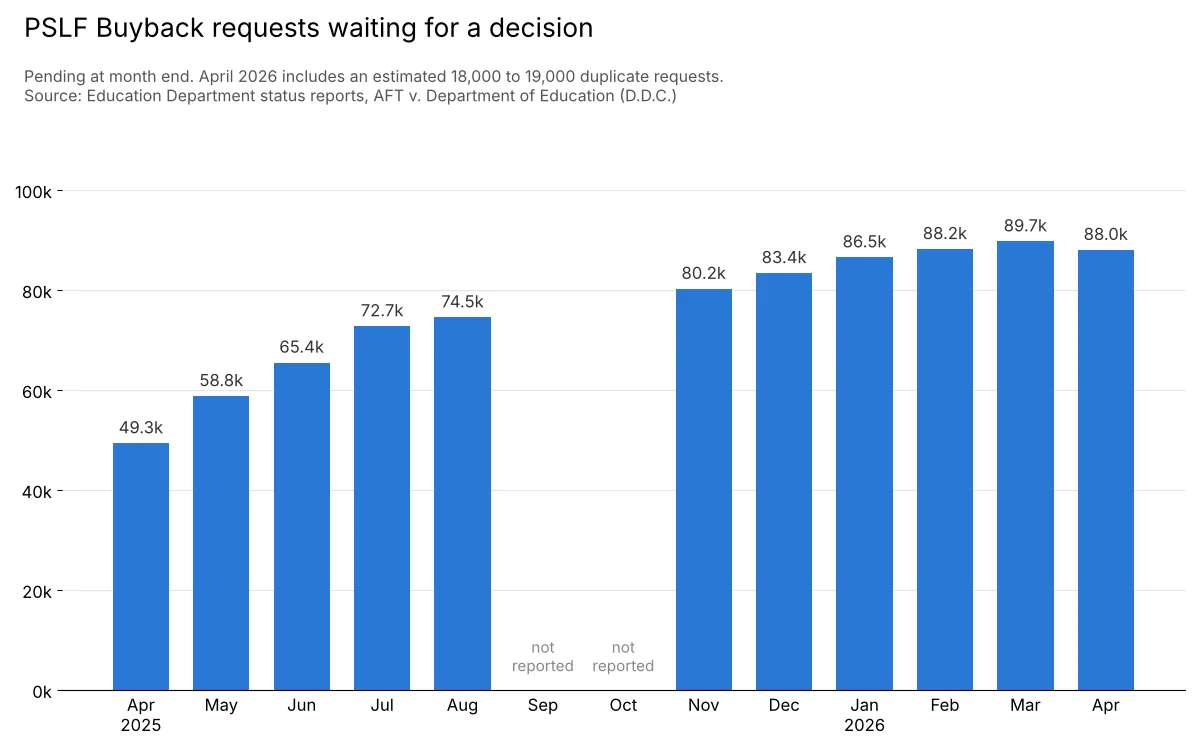
Much of the case rests on figures the department has filed in a separate AFT lawsuit, AFT v. Department of Education, in which it files monthly status reports. Pending buyback requests grew from 49,318 at the end of April 2025 to 89,720 at the end of March 2026.
April 2026 was the first month the department decided more requests than it received: 6,870 decisions, including 6,600 approvals and 200 denials, against 4,790 new requests. That still left 88,000 pending. The department said in that filing that the figure includes an estimated 18,000 to 19,000 duplicate requests from borrowers who applied more than once, which it planned to remove. It also reported 11,500 PSLF discharges that month.
The complaint calculates that even at its fastest pace, the department would need more than 18 months to clear the April backlog, before counting new requests.
How buyback is supposed to work
The department created buyback in a rule published Nov. 1, 2022. A borrower can buy back a month only if they worked for a qualifying employer during it and the bought-back months bring their total to at least 120. According to the complaint, a borrower currently needs 120 months of qualifying employment before applying, then gets an agreement listing each month and its cost, and has 90 days to pay.
Several of the named plaintiffs had been on the SAVE plan. Nearly 8 million SAVE borrowers were moved into a forbearance in mid-2024 after courts blocked the plan, and those months did not count toward PSLF, the complaint says. The department later said in court that SAVE forbearance months can be bought back, according to its May 2025 report.
What the suit asks the court to do
The plaintiffs want the court to declare that the department broke the Administrative Procedure Act and to order it to process buyback requests on time, restore the removed credit, post qualifying payments and cancel the loans of everyone who has met the program's requirements. They propose three classes: buyback applicants waiting more than 90 days, borrowers whose credit was cut, and borrowers whose recent payments were not posted. If a judge certifies the classes, a ruling would cover borrowers who fit them, not only the named plaintiffs.
The case was filed Friday, and under federal court rules the government generally has 60 days after it is served to answer a complaint.
What borrowers can check now
Log in to StudentAid.gov and look at your PSLF tracker. Compare your current count with any earlier screenshots or letters, and note whether months after June 2026 have posted. Keep any notice about a payment count reduction.
The department requires borrowers to keep making scheduled payments while a buyback request is pending, the complaint says, and it has said extra payments beyond 120 will be refunded after forgiveness.