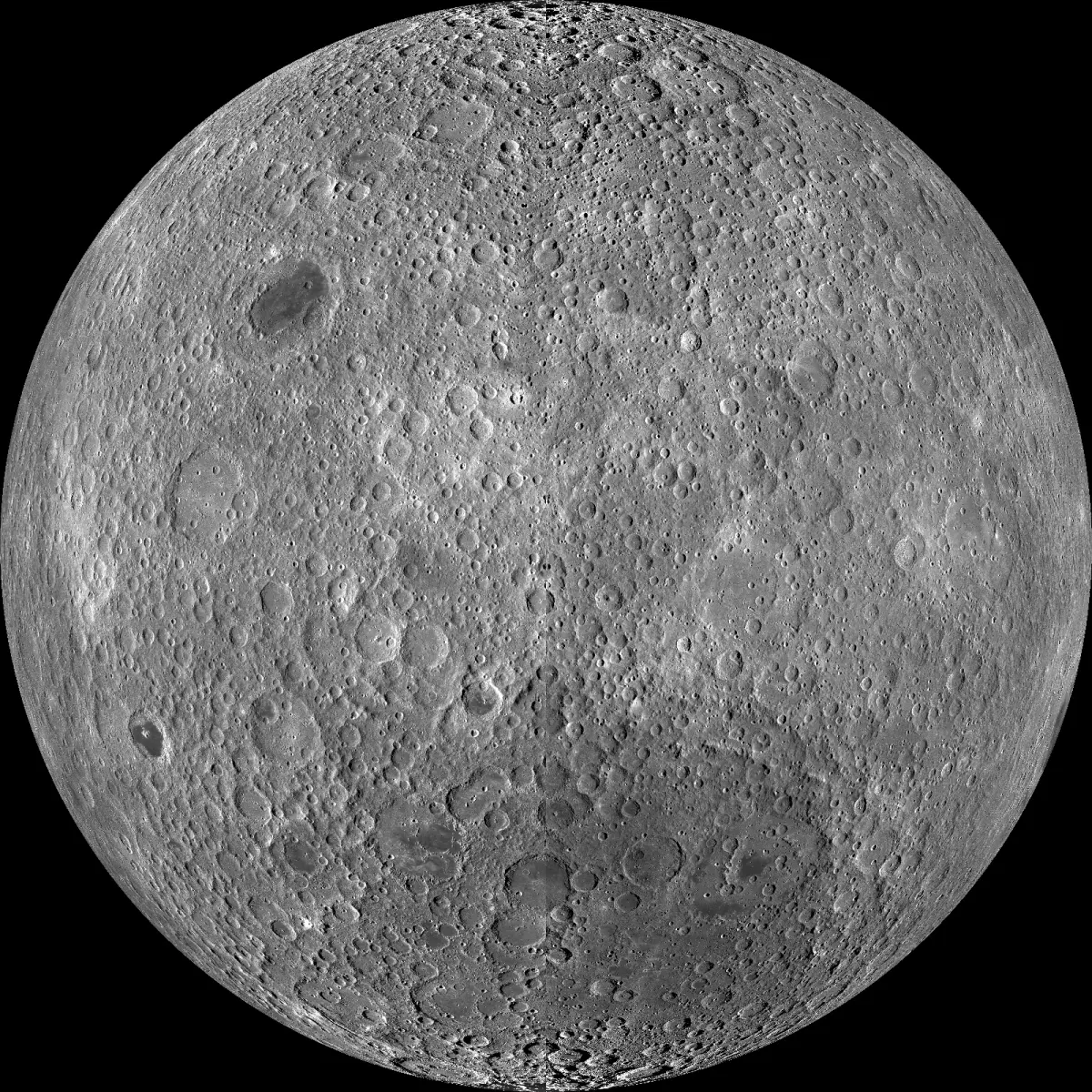
The Moon's far side looks markedly different from the familiar face visible from Earth. A NASA picture feature published October 10 showed a Lunar Reconnaissance Orbiter mosaic covered in craters, with far fewer of the broad dark plains that mark the near side.
The feature used observations collected between November 2009 and February 2011. The October feature explains that existing mission imagery.
Far side does not mean permanently dark
| Term | What it describes |
|---|---|
| Far side | The hemisphere that normally faces away from Earth because the Moon's rotation is synchronized with its orbit. |
| Dark plains | The smoother lunar maria that are much more extensive on the near side in this comparison. |
“Far” names a viewpoint. It does not mean the hemisphere is permanently without sunlight. A caption that calls it the “dark side” can therefore confuse a location with lighting.
NASA points to the thicker crust on the far side as a likely reason molten material had more difficulty reaching the surface to create smooth plains. That explanation connects the visible texture to the Moon's interior history.
NASA’s Moon facts explains that the Moon keeps the same face toward Earth as it moves around us. It rotates as it orbits. The hemisphere facing away from Earth still receives sunlight, so the far side and the unlit portion of the Moon are different things.
NASA's feature says the global mosaic used more than 15,000 images and that its highest-resolution form reaches about 100 meters per pixel. A phone-sized copy cannot show all the terrain detail in the full-resolution mosaic.
A mosaic assembled from observations over more than a year is a mapped presentation, not a single instant of sunlight over the hemisphere. Its tones do not represent one particular day’s sunrise or sunset.
Why the same face keeps turning toward Earth
NASA's tidal-locking explanation describes how Earth's gravity distorted the young Moon and dissipated rotational energy as heat. Its spin slowed until one rotation took as long as one orbit. The matching periods keep the same hemisphere facing us.
The Moon still turns relative to distant space. If it did not rotate during its orbit, Earth would eventually face every part of its surface. The synchronized turn is what prevents that ordinary change of viewpoint. A spacecraft traveling around the Moon can see terrain that remains beyond our usual Earthbound view.
The near and far sides are geographic halves. Their names stay attached to the same terrain while sunlight moves across it. "Day side" and "night side" instead describe illumination at a particular time. A place can lie on the far side and experience daylight without any contradiction.
Small changes in viewpoint do occur. NASA calls the Moon's apparent rocking "libration." Its elliptical orbit changes how fast it moves relative to its steady spin, allowing observers to glimpse a little beyond the usual eastern or western edge. The orbit's tilt also reveals more around the poles. This slight extension of our view leaves most far-side terrain hidden.
A lunar month changes the lighting
NASA's guide to lunar phases explains that sunlight illuminates half the Moon as its position changes around Earth. During a full Moon, the near side faces the Sun and appears bright to us. Around new Moon, its sunlit hemisphere faces mostly away from Earth.
That geometry means a far-side view taken near new Moon could show broadly sunlit terrain while the familiar face is dark. The name of the hemisphere tells us where a camera is looking; the phase tells us about the Earth-Sun-Moon arrangement. Neither term describes how dark the rock itself is.
The maria are dark surface material. A sunlit plain can therefore look darker than sunlit cratered highlands beside it. An area in nighttime shadow is dark for a different reason. Those two causes can look similar in a small image but imply different things about the scene.
At the poles, some crater interiors remain permanently shadowed because sunlight reaches them at a low angle. NASA's Moon facts locates concentrations of water ice in dark polar craters. Those are particular terrain features, rather than an entire permanently dark hemisphere.