The National Museum of Asian Art brings 26 Louvre objects into a presentation about their movement from places of origin to a Paris museum. From the Louvre: Masterpieces of Islamic Art opened at the National Museum of Asian Art on September 26, 2026, with a run through January 18, 2027.
Among the featured objects is the metal basin commonly known as the Baptistery of Saint Louis, signed by Muhammad ibn al-Zayn and made in Syria or Egypt around 1330 to 1340.
One basin, several histories
The museum's object caption separates the basin's manufacture from later additions. It places the engraved and inlaid copper-alloy vessel around 1330 to 1340 and identifies coats of arms of the House of France added in Paris in 1821. It also records entry into the Louvre in 1793. A single object can therefore carry more than one historical moment on its surface and in its catalog record.
The French coats of arms belong to a later use of a vessel made in a Mamluk setting. Its familiar French nickname reflects one part of that history, while the maker’s signature and the place of manufacture identify an earlier one.
The museum's exhibition announcement places the selected objects across the seventh through nineteenth centuries and regions from modern-day Spain to India. With just 26 works covering that span, the show is a selection of individual histories, not a complete chronological survey.
The exhibition is in the museum's East Building, Galleries 23 and 24. That is the destination for this loan exhibition, rather than the Louvre in Paris or a general tour of the museum’s collections.
Check the museum's visitor page for current entrance information and accessibility arrangements. Exhibition dates establish when a display is scheduled; they do not establish that every entrance or gallery is available for the full span of the museum day.
Metal, sculpture and royal portraiture
The exhibition's named examples include an Andalusian bronze lion and a jeweled portrait of a Persian king as well as the basin. These are different uses of an image. A vessel combines decoration with a container's physical shape; an animal sculpture gives the subject a body in three dimensions; a royal portrait presents a particular kind of public identity. That range helps explain why a small selection can take more time than its object count suggests.
The Louvre's collection record for the basin identifies hammered brass with engraved decoration and silver and gold inlay. Its diameter is 50.5 centimeters, roughly 20 inches, and its height is 23.2 centimeters, about nine inches. This is a substantial vessel, not a small jeweled cup. Its metallic surface joins structural work and decoration: hammering forms the body, while engraving and inlay create contrasts across it.
A photograph can flatten those differences into one gold-colored surface. The catalog's material description separates the metal body from the metals inserted into the decoration. That distinction also explains why workmanship belongs in the story alongside subject matter. Images of people and animals occupy a surface that had to be made, shaped and finished before it could carry those details.
The Louvre dates the work to 1325 to 1340, a slightly wider range than the exhibition caption's approximately 1330 to 1340. Both describe a fourteenth-century Mamluk object. Neither gives a precise year of manufacture. The catalog also records its museum acquisition on January 26, 1793, independently of the later French heraldic additions.
Free admission and the right building
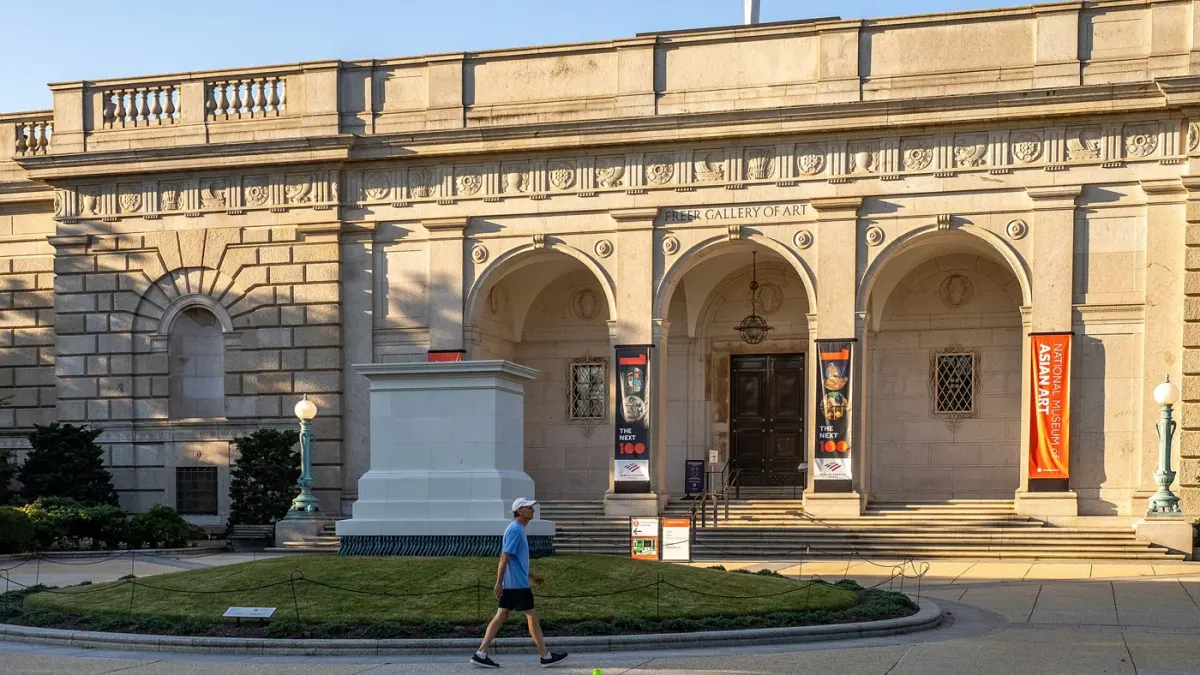
The museum's hours and admission page lists free admission and daily hours of 10 a.m. to 5:30 p.m. The loan exhibition is in the East Building, while the exterior photo with this article shows the Freer building. Use the museum's directions for the exhibition galleries.
The visitor rules allow non-flash photography except where prohibited and exclude tripods and selfie sticks. Bags larger than 17 by 26 inches are not permitted in the galleries, and nothing may be carried on the back. These details are useful when arriving from another Washington stop with luggage or a full daypack.