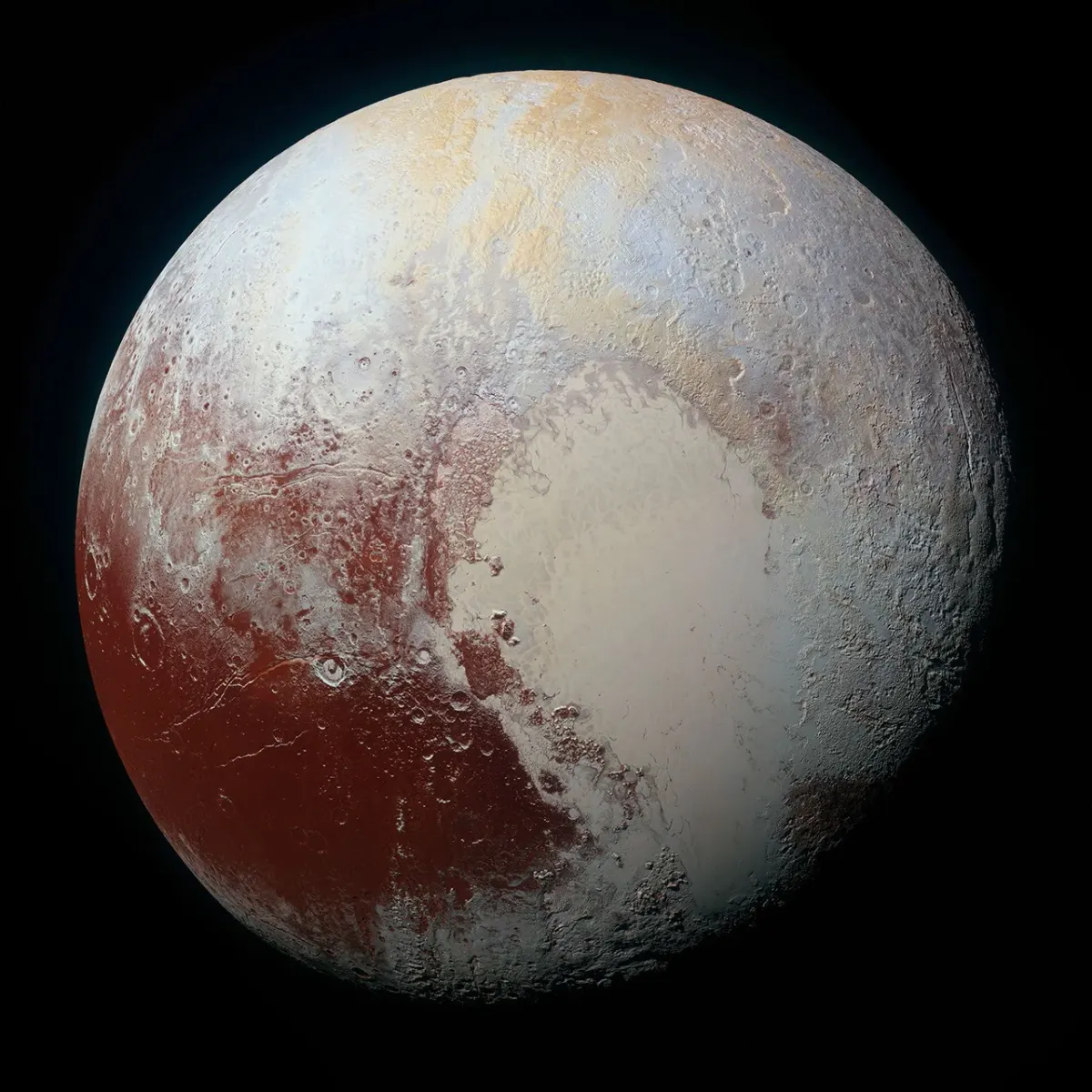
The pale heart on Pluto becomes more complicated when the colors are enhanced. NASA's Astronomy Picture of the Day for September 6 revisited a New Horizons view that combines color measurements with high-resolution images from the spacecraft's July 2015 flyby.
The observation comes from July 2015; the September 6, 2026 date identifies NASA's picture feature. These are different points in the same image's history.
Enhanced color has a practical scientific purpose here. NASA explains that it makes areas with different chemical compositions easier to distinguish. The heart-shaped Tombaugh Regio contains two geologically different regions, including the especially smooth western lobe called Sputnik Planitia.
What enhanced color reveals
A space photograph can represent real measurements while showing contrasts more strongly than human eyes would. NASA's original image record documents the processing and the observing instrument. That accompanying information is part of the image's meaning.
Blue, red and infrared measurements
NASA's image record identifies the Ralph/Multispectral Visible Imaging Camera, or MVIC, and says the view combines blue, red and infrared images taken on July 14, 2015. Infrared measurements do not map directly onto the colors a person would see through a window. The displayed palette helps communicate differences in the observations.
The record gives a resolved scale as small as 0.8 miles, or 1.3 kilometers. That resolution reveals broad landforms rather than individual small objects. Enlarging the displayed picture does not add detail beyond the spacecraft’s observations.
The original image is cataloged as PIA19952 and credited to NASA, Johns Hopkins University’s Applied Physics Laboratory and Southwest Research Institute. The record identifies both the observations and the processing behind this particular view.
The terrain behind the palette
NASA's Pluto facts describe mountains built from water ice and plains that appear to consist of frozen nitrogen. At Pluto's temperatures, the familiar word ice covers materials with very different behavior. Water ice can provide the rigid blocks of a mountain while more volatile frozen gases occupy lower terrain. A smooth, pale area and a rugged ridge can therefore represent different geology as well as different shades.
The tallest mountains reach roughly 2 to 3 kilometers, or 6,500 to 9,800 feet. The nitrogen plains show structures consistent with convection, the circulation of material upward and downward, and lack the conspicuous cratering of older terrain. Those observations make the heart more interesting than its familiar outline: neighboring parts of the same dwarf planet can preserve different surface histories.
Color alone cannot date a plain or measure a mountain. Those interpretations require the shape of the terrain and other measurements. A bright patch in this view is not a temperature reading, and a red patch does not establish the presence of a particular substance without further analysis. The palette makes boundaries easier to follow; the scientific explanation supplies what those boundaries mean.
A globe with finite detail
Pluto's equatorial diameter is about 2,377 kilometers. Using NASA's stated 1.3-kilometer resolved scale, roughly 1,830 such intervals would fit across that diameter. This is a scale comparison, not the image's pixel count: projection, viewing geometry and processing affect the displayed globe. It explains why a full-disk view can reveal large plains and mountain regions while leaving much smaller features unresolved.
New Horizons remains the only spacecraft to have explored Pluto at close range. Its flyby supplied a concentrated set of observations rather than a continuously updated camera above the surface. The September picture feature gives those older measurements another audience. For someone downloading the image, the original record also offers both JPEG and TIFF versions. A larger file can preserve the supplied image more faithfully during editing, but cannot improve the spacecraft's original resolving power.