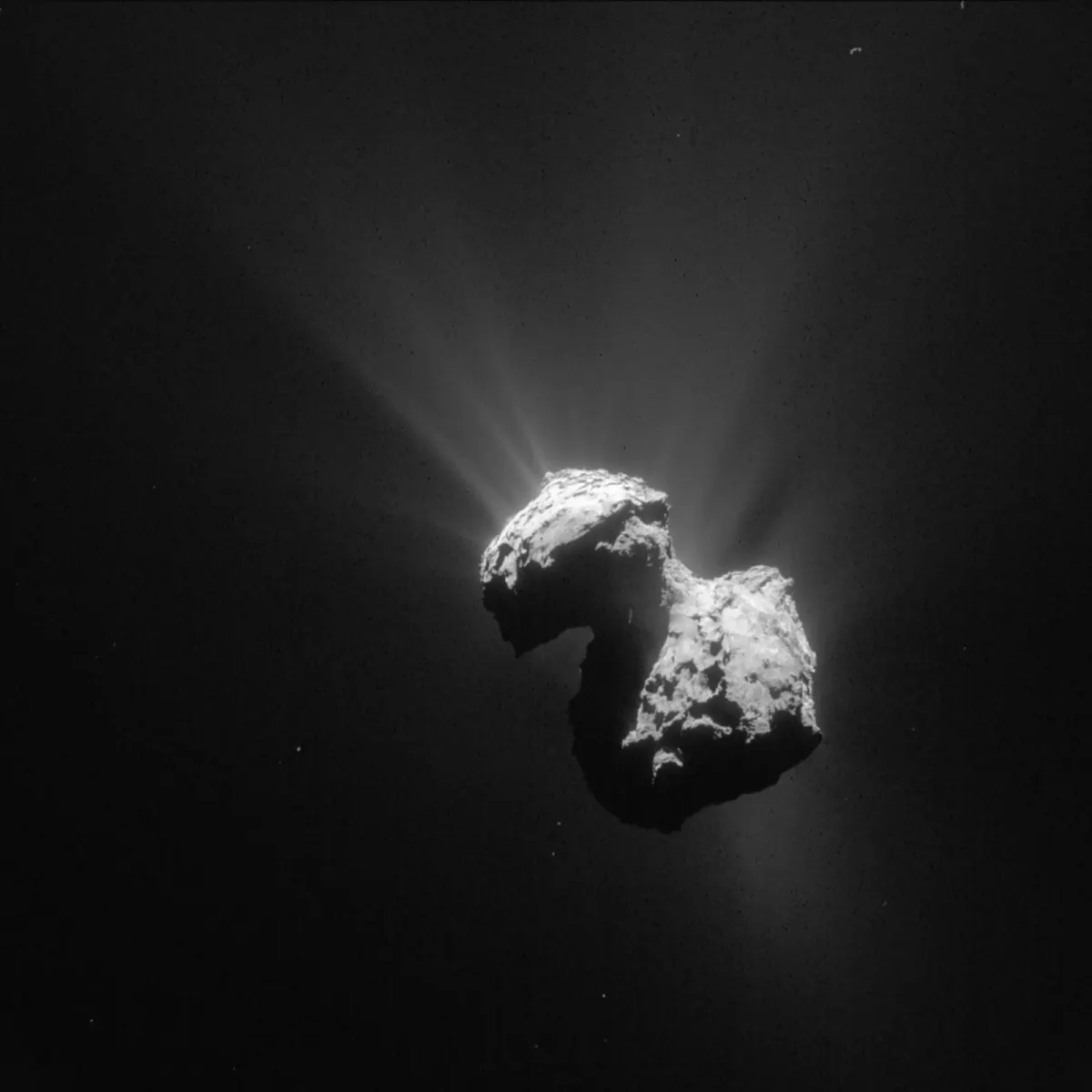
A stereo image of comet 67P offers a different way to read a familiar space photograph. NASA's October 17 picture feature presented an anaglyph made from two Rosetta spacecraft images, intended to be viewed with red-and-blue glasses.
The source observations were taken on July 25, 2015 from about 184 kilometers away. Rosetta's mission ended in September 2016 with a controlled impact on the comet.
The picture shows the comet's two lobes joined by a narrow neck. NASA describes jets from its active surface near its closest approach to the Sun. The stereo treatment helps a viewer separate surface shapes that can overlap in a flat rendering.
An anaglyph places the two viewpoints into differently colored channels. The appropriate glasses direct a different view to each eye, creating the impression of depth. Without them, the colored fringes are part of that construction rather than an account of the comet's natural color.
How the stereo image works
- Open the credited original rather than a compressed screenshot.
- Use the red-and-blue glasses specified for the anaglyph.
- Compare the narrow neck with the two larger lobes.
- Treat the colored fringes as the stereo construction, not surface color.
Rosetta’s mission timeline
The European Space Agency's mission-end account dates Rosetta's final descent to September 30, 2016. The spacecraft lost its signal on impact. July 2015 observations, a September 2016 mission end and an October 2026 picture feature are therefore three separate dates. The new feature presents older observations in a stereo format.
The 184-kilometer viewing distance is roughly 114 miles. That conversion helps put the spacecraft's position in familiar units, but it is not the comet's size or a measure of how far apart the two source viewpoints were. A stereo effect depends on a difference between views; the single distance figure does not describe the whole construction.
The two lobes have a history of their own
The shape was a scientific problem before it became a recognizable comet portrait. Did erosion carve a narrow neck into one body, or did two separate objects join? ESA's 2015 account of the shape study describes how researchers compared layers exposed in cliffs, pits and terraces.
The team mapped more than 100 terraces and used a three-dimensional shape model to work out the orientation of the layers. Their arrangement fit two independently formed bodies better than a single center of mass. Near the neck, the layers inclined in opposite directions. The researchers concluded that the lobes joined in a collision slow enough to preserve the layered structures.
That conclusion came from an analysis across many observations. The anaglyph can make the neck easier to distinguish, but its apparent depth alone cannot establish how the comet formed. A stereo rendering and a model built to test a geological explanation serve different purposes.
NASA gives the larger lobe's diameter as about four kilometers and the smaller one's as about 2.5 kilometers. Neither is a sphere, and those dimensions are approximate descriptions of the lobes. The spacecraft's 184-kilometer observing distance is much larger than either one.
The comet changed as Rosetta watched
ESA distinguishes the shape's origin from the erosion that continued afterward. Sublimation, the direct change from ice to gas, affected different parts of the layered surface at different rates. Jets and the solid nucleus belong to that active environment.
Rosetta arrived in August 2014, deployed the Philae lander that November and observed the comet through its close approach to the Sun. The mission-end account explains that the final descent returned close-range measurements of gas, dust and plasma as well as high-resolution pictures. Those observations reached Earth before impact; the spacecraft could no longer communicate afterward.
The cover image accompanying this article is a single Rosetta navigation-camera photograph from July 7, 2015. The July 25 stereo pair discussed in NASA's feature came from OSIRIS. Their dates and instruments identify separate observations of the same comet.