
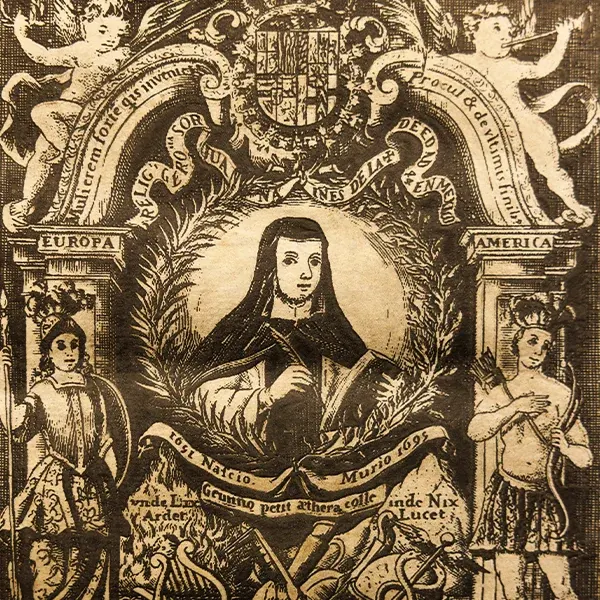
Sor Juana Inés de la Cruz's defense of women's learning becomes sharper when the reader knows who was supposedly advising her. The name Sor Filotea belonged to a bishop writing under a female pseudonym, rather than a fellow nun.
The Library of Congress's October 15 account highlights its 1700 first edition of Fama y Obras Posthumas del Fénix de Mexico. The volume includes Sor Juana's Respuesta a Sor Filotea, written in 1691. Reading the reply as an exchange gives its irony an identifiable target.
The Library describes a writer who defended the study of secular subjects as necessary to understanding scripture. Her position was built within the terms of the argument being used against her. A modern quotation detached from that dispute can make the reasoning harder to see.
English editions present the reply through a translator’s choices. The digitized early Spanish edition also has spelling and letterforms that differ from modern transcriptions.
A 1691 reply in a 1700 volume
The Library's digitized volume record identifies a Madrid publication printed by Manuel Ruiz de Murga in 1700. That is the date of this edition, nine years after the reply was written. A reader needs both dates: one locates the dispute, and the other locates the book that carried the writing to later readers.
The title describes posthumous works. Its front matter and arrangement belong to the people presenting Sor Juana after her death, as well as to the writer whose words appear inside. That later presentation is part of the book’s history, alongside Sor Juana’s own argument for learning.