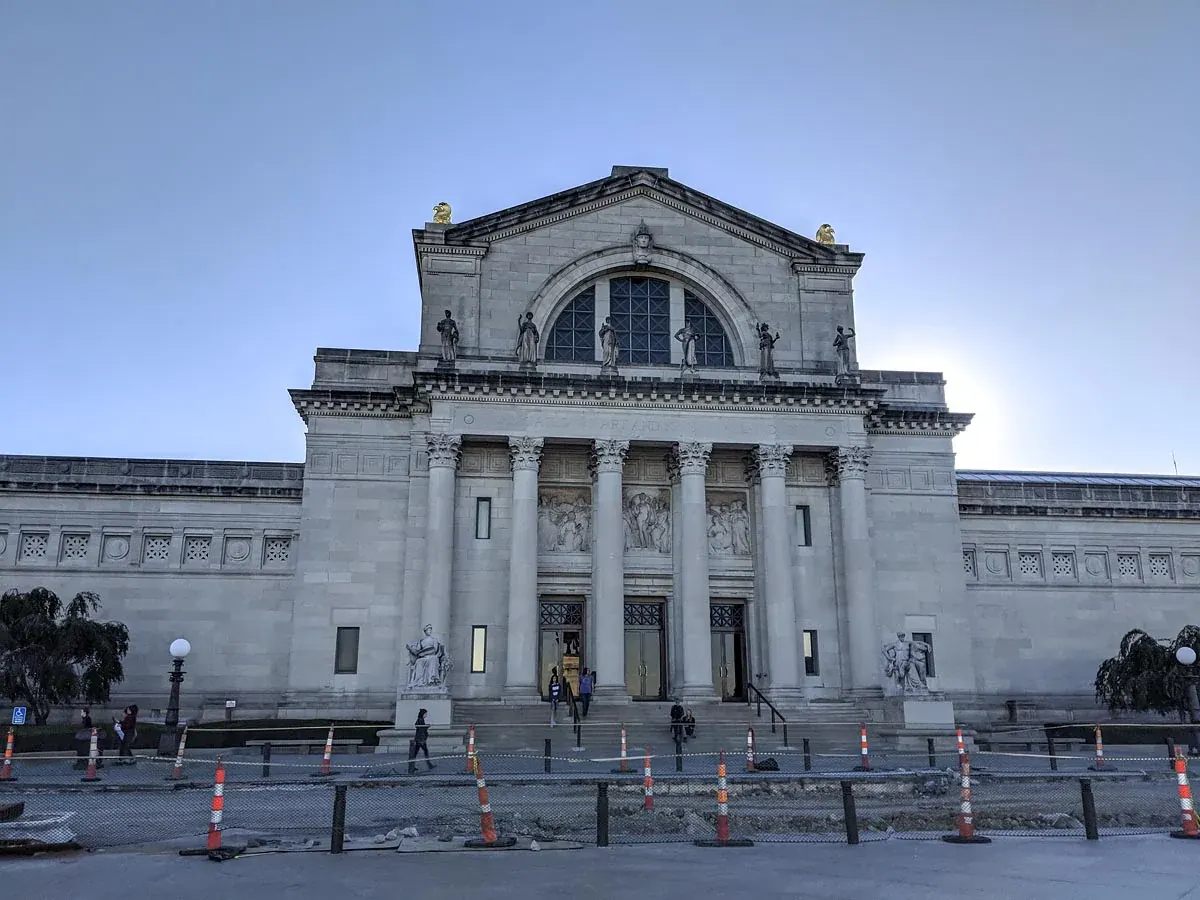
Aymara Weavings: The Indigenous Andes reaches its final scheduled day at the Saint Louis Art Museum on Sunday, September 13. The free Gallery 100 presentation brings Aymara garments and related Central Andean works into a focused textile exhibition.
The museum's exhibition page dates the free presentation from January 30 through September 13, 2026, in Gallery 100. On its final scheduled Sunday, it was a sensible priority for visitors already going to Forest Park who were interested in textiles, design or Indigenous art.
The display featured skirts, mantles and ponchos, primarily from the eighteenth and nineteenth centuries, made by Aymara artists and related works from the Central Andes. The museum connected these works to the ways artists in Bolivia maintained and changed artistic practices during the colonial era. That context gives a visitor a reason to read beyond color and pattern.
Warp-faced weaving and camelid fibers
The museum identifies warp-faced weaving as central to the exhibition. Repeated vertical elements establish the larger design, with changes in spacing, scale and color across the textiles.
The exhibition description names hand-spun and hand-dyed camelid fibers, including alpaca and vicuña. Consider how the material might affect an object's surface and use, while leaving technical conclusions to the museum's interpretation. A visitor's visual impression alone cannot identify a fiber or establish how a piece was worn.
The museum's two illustrated mantles give the closing-day visit a specific comparison. The woman's mantle, identified as an ahuayo, measures 33 by 34 inches. The man's mantle, identified as a llacota, measures 46 by 49 inches. Both are attributed to Aymara artists and broadly dated to the eighteenth or nineteenth century. The different dimensions distinguish the two mantles even where their banded designs look related.
The selected works came from a 2018 gift by Paul and Elissa Cahn. That acquisition date belongs to the museum history, while the textiles' dates belong to their manufacture. The eighteenth- and nineteenth-century works entered this collection much later, in that 2018 gift.
This was a good choice for someone who wants one focused subject rather than an entire collection survey. A short visit can still involve close attention if you choose two textiles to compare and read their labels fully. The museum lists free general admission, though individual exhibitions can have their own terms; this presentation was explicitly free. For later visits, use the collection records or a new program listing, since the September closing applies to this particular installation.