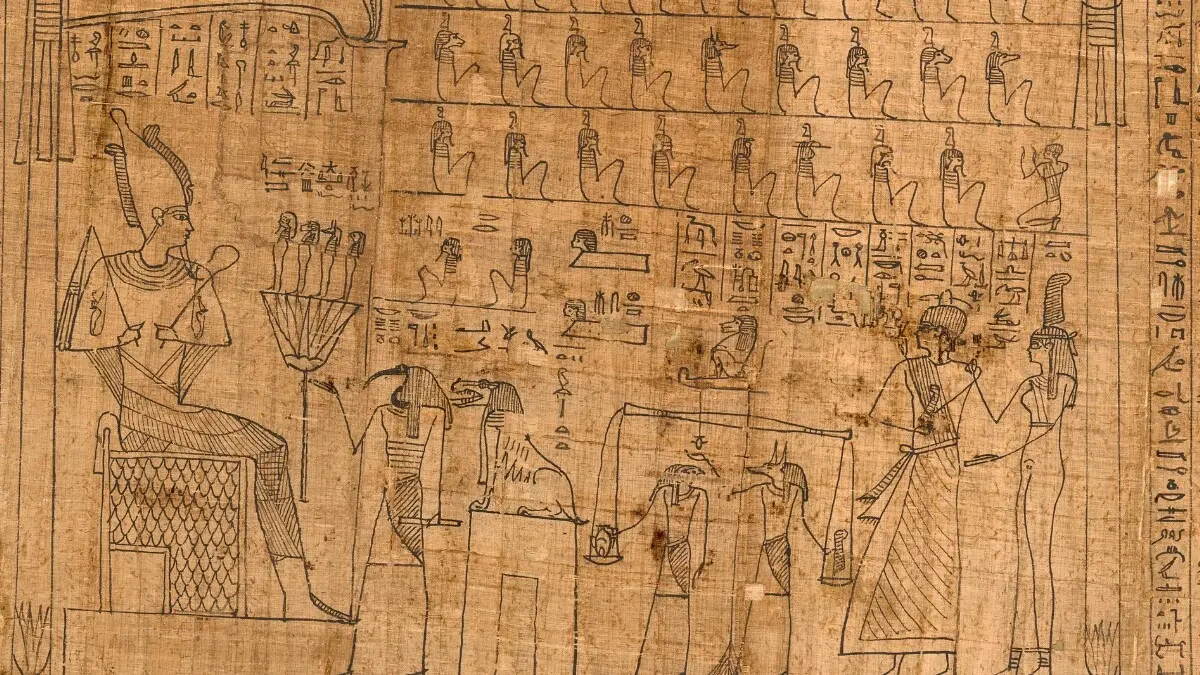
The title Book of the Dead suggests a single ominous volume. The Getty Villa exhibition offered a more specific encounter with ancient Egyptian texts: surviving papyri and pieces of linen carrying words and images intended to help a person after death.
The 2026 exhibition page lists March 4 through November 30 at the Villa, with English and Spanish presentation. For September visitors interested in writing, religion or the way fragile material survives, it supplied a focused destination within the museum.
Texts on linen and papyrus
The selected works included the mummy wrapping of Petosiris, son of Tetosiris, and papyri associated with Pasherashakhet and Ankhesenaset. The surviving texts appear on different surfaces, from papyrus to linen wrapped around a mummy. Their words and images were made for those particular funerary objects.
Getty's explanatory article places these manuscripts in the context of texts meant to assist the deceased. That context explains the purpose of the words and images on the surviving material.
Choose how much reading to take on
The exhibition's online resources offer several different commitments. Use the image-based online exhibition for an introduction before traveling. Use the translation of Petosiris's wrapping when the writing itself is the attraction. A recorded discussion is a better choice when you want an Egyptologist's explanation to accompany the images.
| Route | Best fit |
|---|---|
| Online exhibition | A first look at the objects and their purpose |
| Petosiris translation resource | Readers interested in a particular text |
| Recorded event | Visitors who prefer a spoken explanation |
| Gallery visit | Seeing the scale and material of the surviving pieces |
Keep the identities attached to the objects distinct. The exhibition lists wrappings for two different men named Petosiris, one son of Tetosiris and one son of Nanesbastet. Their shared name does not make their objects parts of the same person's burial. The fathers’ names distinguish the two owners in the exhibition’s descriptions.
Getty's explanation identifies nearly 200 known spells, assembled in different combinations on funerary objects. That makes the title a collective term rather than a guarantee that two manuscripts contain the same sequence. Different owners could have different selections of texts on their funerary objects.
Spell 125 gives a concrete reading route: Getty describes a declaration denying misdeeds before Osiris and an accompanying image of the heart being weighed. The scene connects an image of judgment with words intended to be spoken by the deceased.
The exhibition is included with a free timed-entry reservation, while parking has a fee. Reserve the Getty Villa, which is separate from the Getty Center. At home, the exhibition page links to an online presentation, a translation resource for Petosiris's wrapping and recorded discussions. Start with the online exhibition before deciding whether to buy a specialist book; it can help identify the particular text or question you want a longer publication to answer.
How the fragments reached Getty
The manuscripts have a modern collecting history as well as an ancient religious purpose. Getty's account traces the papyri and wrappings through nineteenth-century collector Sir Thomas Phillipps and later New York bookseller Hans P. Kraus. Kraus and his wife, Hanni, donated them to Getty in 1983. Additional bandages from the same individuals are held in other collections, leaving researchers to reconstruct material that became physically separated.
A fragment's present outline therefore reflects more than ancient damage. Its passage through collecting and sale can also affect what a museum holds together. Reading one surviving strip cannot establish that every related passage from its original funerary setting is present beside it. Getty identifies provenance research and the study of related manuscripts as continuing work.
The exhibition's dated objects also show the breadth of the tradition. Ankhesenaset's papyrus is assigned to about 1069 to 900 BCE, while the Pasherashakhet papyrus is dated about 375 to 275 BCE. Even the closest endpoints are separated by more than five centuries. Seeing them under the same modern title should not erase that chronological distance or imply a single fixed edition circulated throughout it.