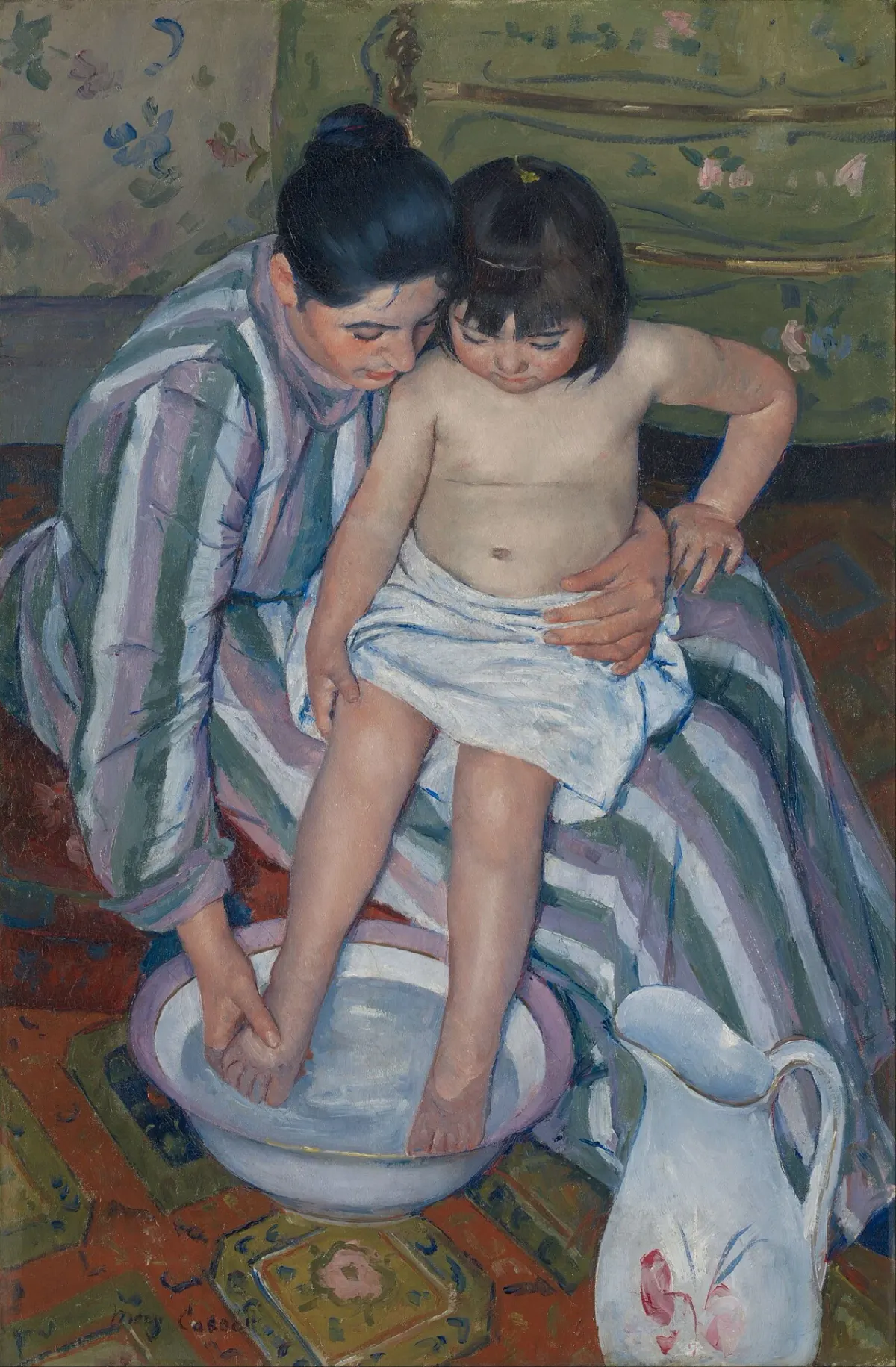
Mary Cassatt: After Impressionism at the Art Institute of Chicago follows the artist after the final Impressionist group exhibition in 1886. Paintings, pastels and color prints show how she returned to related subjects while changing the means of representing them.
The museum's exhibition presentation dates the show from September 6, 2026 through January 3, 2027. It gathers more than 75 paintings, works on paper and mural-related objects, following Cassatt into the early twentieth century. This later work has enough range to sustain an exhibition of its own.
Painting, pastel and color prints
Changes in medium are central to the show. The arrangement of figures and rooms in a painting can be compared with the visible marks of pastel or the outlines and areas of color in a print. Related subjects make those technical differences easier to see than a sequence of unrelated scenes would.
The exhibition's attention to color printmaking also continues in the museum's 208-page catalog. Its essays cover Cassatt's later work, her print The Fitting and the Chicago mural commission. The discussion of different impressions of The Fitting examines variations within a work that might otherwise be treated as a repeatable copy of one finished image.
The lost Modern Woman mural
Cassatt made Modern Woman for the Woman's Building at Chicago's 1893 World's Columbian Exposition. Villa Albertine's partnership page explains the commission's connection to women's education and creativity.
The original mural is lost. Studies, archival descriptions and reconstructions preserve different kinds of evidence about it; none gives visitors access to the finished original. The surviving material allows the show to address the commission's aims while acknowledging what can no longer be inspected.
Before traveling, follow the museum's exhibition page to current admission and access information. Whether a special-exhibition ticket is needed can depend on the date and membership category.
A print can change while its subject stays familiar
The Fitting supplies a concrete example of Cassatt's experimentation. The Met's record of an early impression dates the print to 1890 and 1891 and identifies it as the second of seven states. Printed in black from a single plate, it establishes the figures before the artist added the lines of the wall and mirror. Those later additions changed the room around the figures. A change of state can therefore alter a composition, while a different impression can also reveal decisions made during printing.
The Met explains that Cassatt used black impressions to monitor designs that would later appear in color. Its online example provides context for the Chicago catalog's discussion; this is not a claim that the Met's particular sheet traveled to Chicago. It helps explain why several sheets bearing the same title can be worth sustained attention. They may record different stages in making the image.
The catalog identifies The Fitting as one of a set of ten color prints made with printer Modeste Leroy. That named collaboration complicates the idea of a print as a mechanical duplicate of a painting. The work involved an artist developing an image for the printing process and a printer helping bring it onto paper. The resulting lines, color areas and unprinted paper have their own visual character.
Domestic subjects and a public commission
The mural makes a striking change in scale. Villa Albertine identifies Bertha Honoré Palmer as its commissioner and describes women and girls in an orchard, making music and dancing. Everyday female life, already a concern of Cassatt's smaller works, entered a building created for a world's fair. The setting gave that subject a public audience.
The show's paintings, prints and mural evidence also create different viewing distances. An intimate printed sheet can reveal revisions in a line; archival material for a monumental mural asks the viewer to imagine an absent larger surface. That range gives the exhibition a clear reason to focus on the years after 1886. Cassatt's familiar association with Impressionism does not explain every medium or ambition in this later period.