Thomas Jefferson's rough draft of the Declaration of Independence puts the making of a familiar document on view. Deletions and substitutions interrupt the handwriting. Edits by John Adams and Benjamin Franklin join Jefferson's own revisions, exposing the work before the finished language became a national reference point.
The Library of Congress exhibition The Declaration's Promise: A Revolutionary Idea places that draft beside later disputes over the Declaration's principles. The Library's announcement dates the exhibition from July 3, 2026, through July 3, 2027, with more than 120 collection treasures.
The Declaration before its final wording
One change sits beneath the visible writing. Jefferson replaced "subjects" with "citizens," a revision the Library confirmed through imaging in 2010. The Library's account of that research locates it in a passage about grievances against King George III. The precise sentence did not survive into the final Declaration.
The revised word shows Jefferson working through the relationship between people and government, but the rough draft and the adopted text are different documents. A phrase visible on a manuscript page may have been considered and then discarded.
Preservation scientist Fenella France used hyperspectral imaging in 2009 to separate traces of the overwritten word. The method photographs material under different portions of visible and nonvisible light. It can reveal differences that ordinary viewing cannot resolve. The finding is therefore about the physical evidence in the draft as well as the political meaning of its vocabulary.
Later Americans disputed the promise
The exhibition extends beyond the founding generation. Its announced objects include Frederick Douglass's speech on the meaning of July Fourth, John Quincy Adams's arguments in the Amistad case and a National Woman Suffrage Association protest read by Susan B. Anthony on July 4, 1876.
These are distinct uses of political language. A speech addresses listeners; a court argument seeks a legal judgment; a public protest challenges exclusion. Their presence prevents the founding document from becoming the end of the story. Later Americans invoked its principles while pressing claims that their own circumstances showed had gone unmet.
The display also includes Lincoln's handwritten Gettysburg Address, the Nicolay Copy, and the first newspaper printing of the Declaration. A draft, a newspaper and a later address served different audiences and circulated in different ways. The printed text's reach belongs beside the manuscript's revisions in an account of how a political idea became public.
Maps of the revolutionary world
The Library's cartography guide adds places and objects to that history. Rigobert Bonne's 1775 terrestrial globe belongs to the revolutionary generation's view of the world. Its hand-colored paper sections cover a body of papier-mâché and plaster.
Nicholas Scull and George Heap's Philadelphia map identifies the State House, now Independence Hall, where Congress adopted the Declaration. The guide identifies its image of the building as the first in any format. A view made before the Declaration records the building in an earlier political setting, before its later national associations.
The map of the federal capital carries a different date distinction. The exhibited 1887 survey map is based on Pierre Charles L'Enfant's 1791 plan. A later representation of a plan is evidence of that plan's continued use and reproduction; its printing date does not date the city's founding. This is the kind of detail that disappears when every historic object is treated as a direct view of 1776.
Gallery access and online records
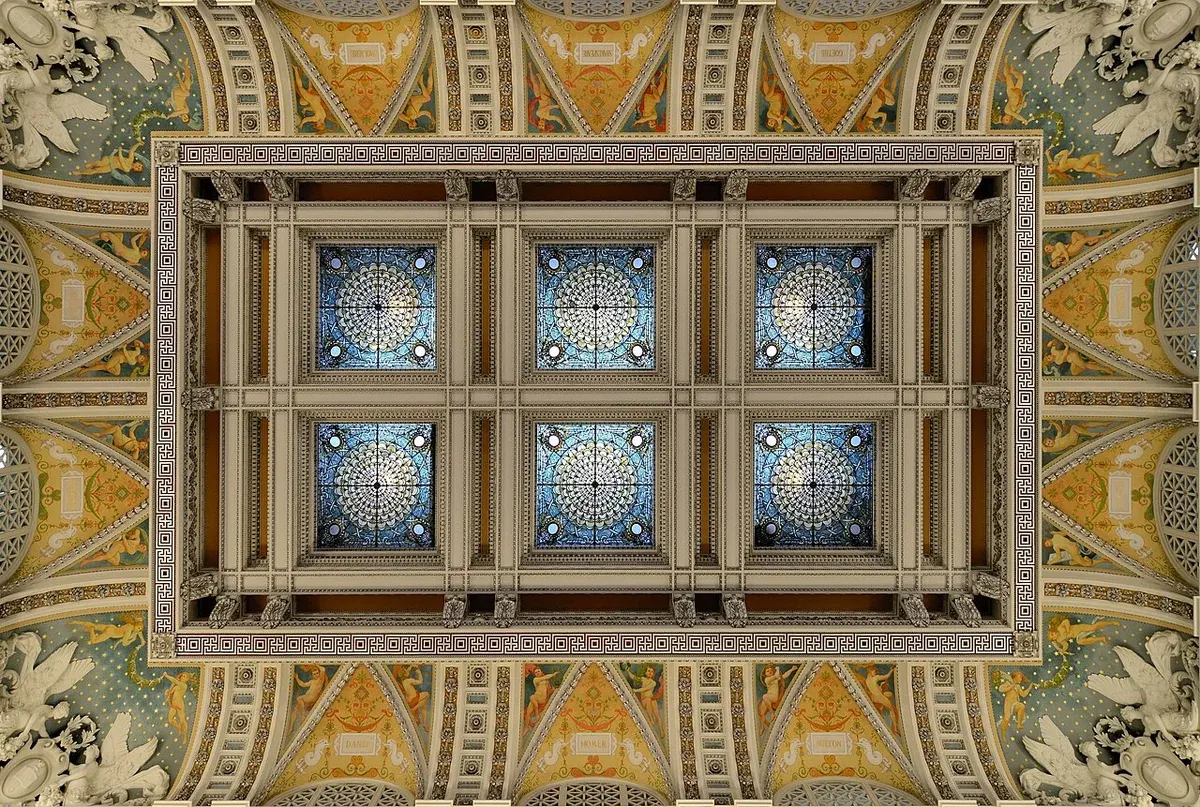
The Library's exhibition information places the show in the David M. Rubenstein Treasures Gallery on the Thomas Jefferson Building's second floor. A free timed-entry ticket is required for a visit.
The cartography guide describes four double-sided display cases and a central table with tactile and listening features. Online object records and the cartography essay give readers a way to examine maps beyond the scale of a gallery case. The Library says pages of Jefferson's draft will remain on view through the exhibition year; a particular opening of the manuscript may differ across visits.