Collins Dictionary has picked "mogging" as its 2026 Word of the Year. The British dictionary publisher defines it as "outperforming or outshining someone or something else," whether in looks, confidence or status, and announced the choice on its blog on Tuesday along with nine other shortlisted words.
Collins says the word is now mostly used as a joke. In its examples, a new release mogs a gamer's old favorite, and a friend's homemade bread mogs the loaf you spent the weekend on.
Where "mogging" came from

Collins traces the word to AMOG, short for "alpha male of the group." Around 2016 it was a noun in bodybuilding circles for the man who physically dominated a gym. It later turned into a verb and spread through the online manosphere before reaching everyday slang.
The publisher also notes a pun British readers will catch. "Moggy" is UK slang for a house cat, which Collins jokes has been mogging its owners from the sofa for years.
The rest of the 2026 shortlist
Collins puts most of the shortlist under the same theme of things trying to outdo one another. Its definitions, in brief:
| Word | What it means |
|---|---|
| Carspreading | New car models growing longer, wider and heavier, modeled on "manspreading" |
| Manchesterism | Regional devolution plus growth and social progress, the politics of UK politician Andy Burnham |
| Firewave | Several wildfires breaking out close together, frequently in urban areas, after extended heat and dry weather |
| Hydration break | A short stop in play so athletes can drink |
| Ghost job | A job ad posted with no plan to hire |
| Friendslop | Cheap, rough indie video games built to play with a group of friends |
| Fricy | Fruity plus spicy, as in mango hot sauce |
| Bixie | A haircut between a bob and a pixie |
| P(doom) | A person's estimate, as a percentage, that AI will cause the collapse of civilization |
The sports entry has a clear US link. Collins says hydration breaks were taken in every match of the 2026 World Cup, which the United States co-hosted with Mexico and Canada, after years of being used only when temperatures passed a set level. On ghost jobs, it cites a UK study that found roughly one in three advertised jobs were not real openings, though the post does not name the study.
Collins dates an early use of P(doom) to 2009, on the forum LessWrong. It says people who rate the chance high are called "doomers," and those who want AI development slowed are labeled "decels." Manchesterism is older still as a word, from the 19th century, but Burnham revived it in a January newspaper piece. Collins notes that by July he had replaced Keir Starmer as prime minister.
Firewave started in a London fire study
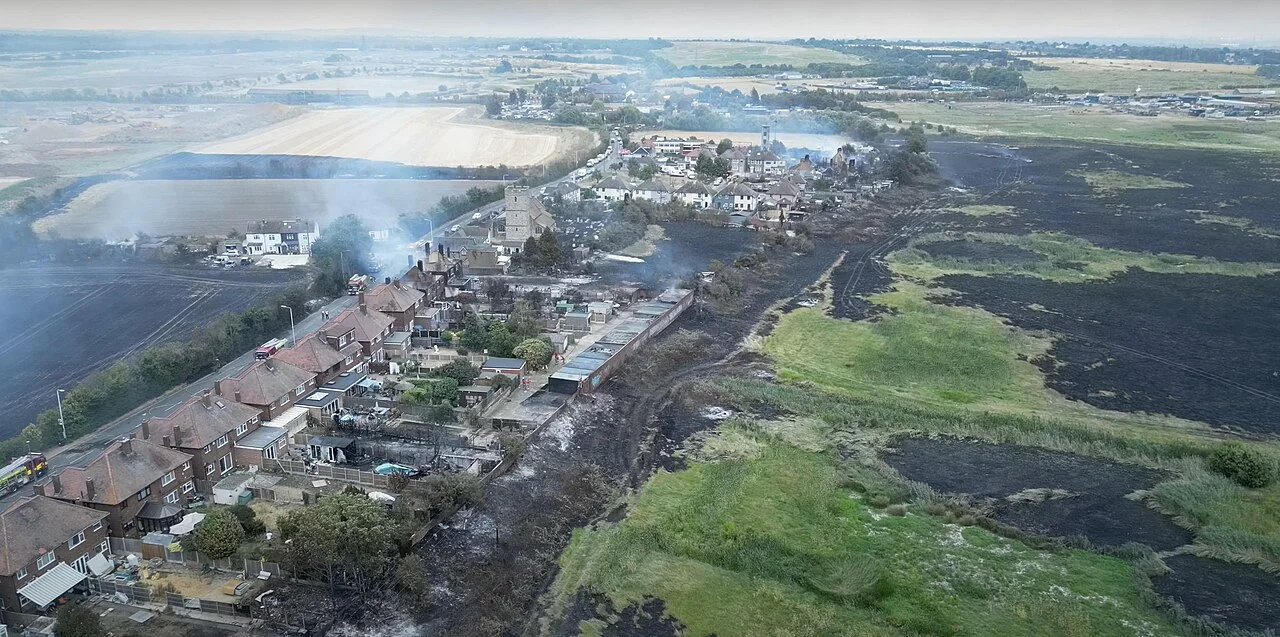
Collins credits firewave to researchers at Imperial College London. The term comes from a 2025 study by Jamie John and Guillermo Rein, "Heatwaves and firewaves: the drivers of urban wildfires in London in the summer of 2022", published in the journal Fire Technology.
The study looked at London Fire Brigade incident records and Met Office weather data from 2009 to 2022. It reports that July 19, 2022, was the brigade's busiest day since World War II. Dry air was the strongest signal. Vapor pressure deficit, a measure of how strongly the air dries out vegetation, explained up to 61% of the variation in the number of London wildfires, compared with 42% for maximum daily temperature. The authors also found that the Met Office heat wave definition, written for public health, does not track how fast vegetation dries, and proposed one based on vapor pressure deficit. They then used the time fire pumps spent at incidents to define a firewave, so the brigade can spot the next one early and prepare.