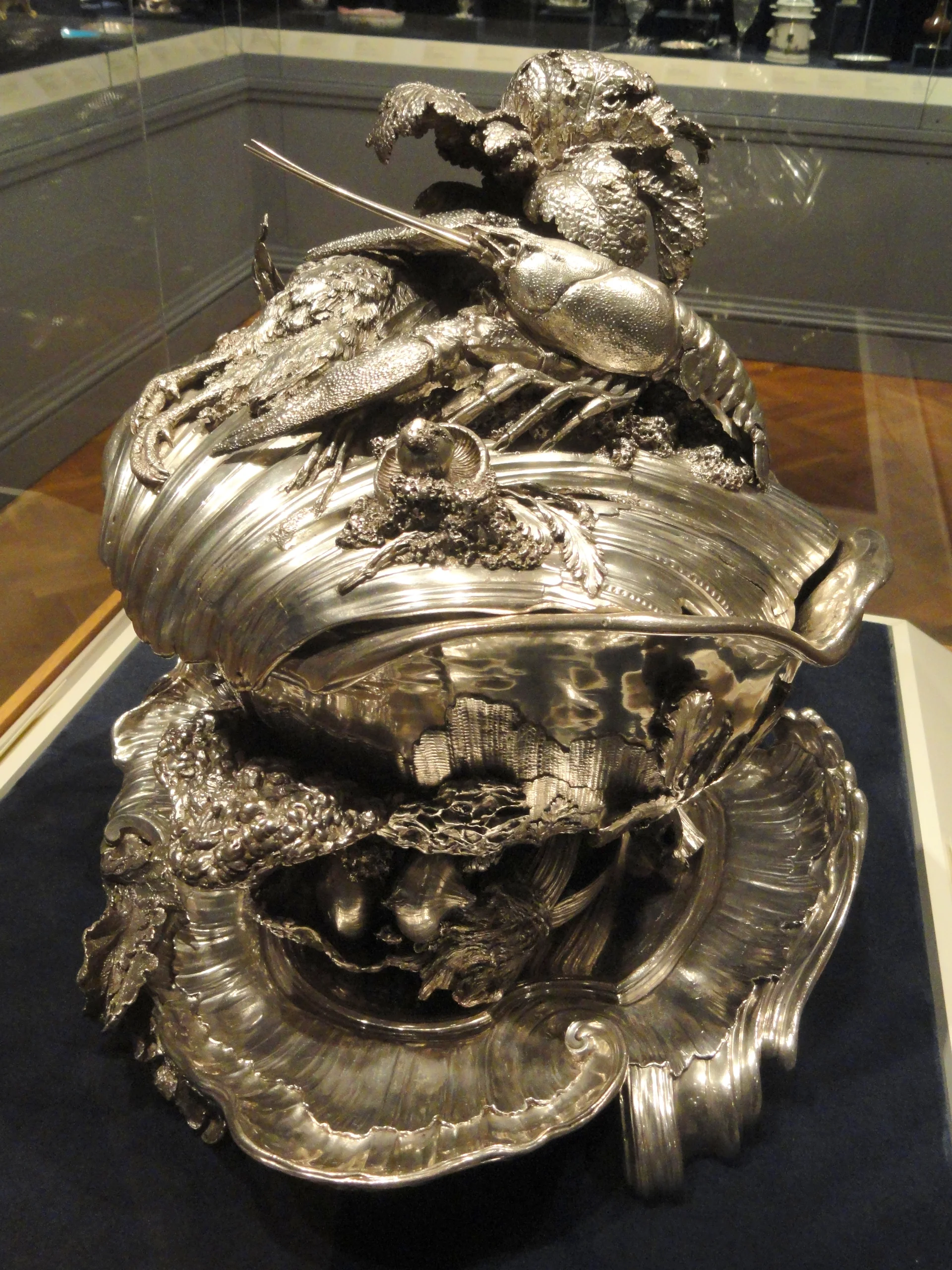
A silver soup tureen once owned by J. P. Morgan is heading to auction in London with a £4 million to £6 million estimate. Its companion is in Cleveland, where visitors can see it in a free exhibition through March 14, 2027.
The two vessels were designed by Juste-Aurèle Meissonnier for the 2nd Duke of Kingston-upon-Hull in the 1730s. One is being offered in The Blaquier-Arrieta Collection at Christie's on December 1. The other anchors Rococo Goldsmith in Focus at the Cleveland Museum of Art, which opened October 25.
The auction piece and its American owner
Christie's dates the London tureen to 1735 to 1740. Its shell-shaped bowl rests on silver celery, onions and a carrot; a duck, crab, fish, oyster and snail decorate the cover. The catalogue records a weight of 20,440 grams, about 45 pounds, and identifies a later liner inscribed with the name Ubaldo Vitali and the date 1998.
The lot's provenance traces it from the duke to his widow, Elizabeth Chudleigh, and through later European collections. Dealer Jacques Seligmann bought it at a Paris sale in December 1909 on behalf of Morgan, the New York banker and collector. It later entered the Thyssen-Bornemisza collection and was acquired by the Blaquier-Arrieta family at a Sotheby's New York sale in 1998.
The £4 million to £6 million figure is an auction estimate, not a completed sale price. Christie's announced the collection in October; the December sale is still ahead.
What Cleveland's counterpart shows
The museum dates its Covered Tureen on Stand to 1735 to 1738 and identifies Meissonnier as designer, with Pierre-François Bonnestrenne and Henry Adnet as makers. Its description gives a weight of nearly 44 pounds.
A crayfish, partridge and vegetables were cast from real examples, according to the museum. These animals and plants refer to the ingredients of the stew, or oille, served in this type of vessel. The curves and uneven arrangement turn the bowl, lid and stand into a single sculptural composition.
Meissonnier asserted his role with an inscription on the stand identifying himself as an architect. The division between designer and silversmiths helps explain why a piece associated with his name also carries the work of other makers. Born and trained in Turin, Meissonnier moved to Paris around 1715, where joining the goldsmiths' guild was difficult for newcomers.
A print that can be misleading
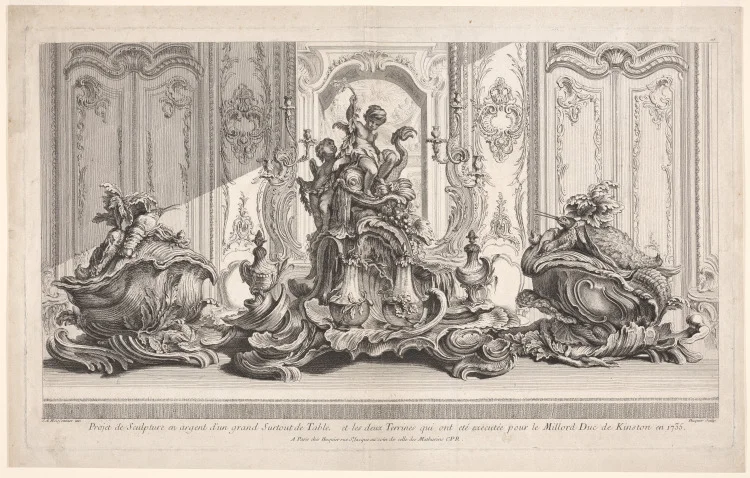
An etching by Gabriel Huquier after Meissonnier, dating to about 1735 to 1737, presents the tableware in an elaborate interior. Despite an inscription referring to two tureens, the museum says the print shows two views of the same vessel, the one now in Cleveland. The other has a crab on its lid instead of a lobster.
The large centerpiece in the print was probably never made, the museum says.
A gold box joins the display
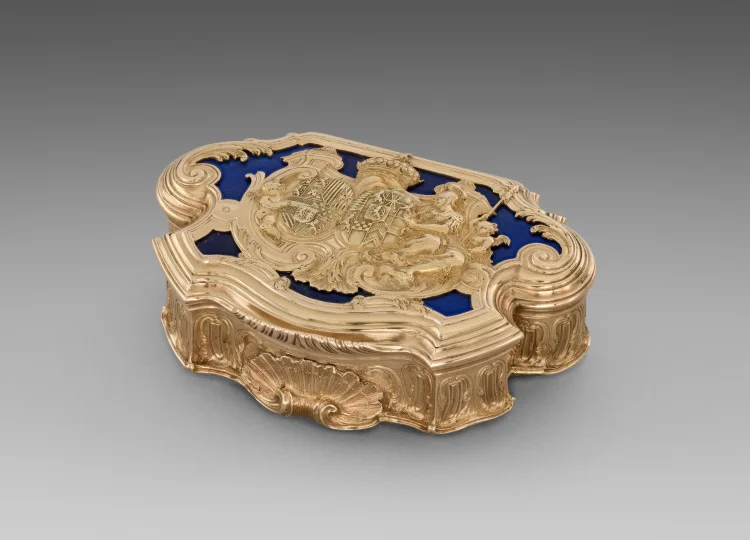
The exhibition also includes Meissonnier's Gold Box, made in 1728 to 1729 for Maria Anna of Neuburg, dowager queen of Spain. Her arms and those of her late husband, Charles II, appear on the cover.
Gold surrounds deep blue lapis lazuli, with fluted sides and a shaped central cartouche. The museum identifies it as one of two known objects bearing Meissonnier's maker's mark. The show brings it together with loans from Paris, including a rock-crystal ewer with gold mounts that belonged to Marie Antoinette.
Visiting in Cleveland
The exhibition is in the Julia and Larry Pollock Focus Gallery, numbered 010. Admission is free and no ticket is required. The museum also provides a 3D model of the tureen online after conservation work and new photography.
The museum is at 11150 East Boulevard. Its current visiting hours are 10 a.m. to 5 p.m. Tuesday, Thursday, Saturday and Sunday, and 10 a.m. to 9 p.m. Wednesday and Friday. It is closed Mondays and Thanksgiving Day. All hours are Eastern.