

The IRS has moved its Dec. 15 hearing on the federal school scholarship tax credit to telephone only. The notice published Nov. 12 gives people who want to speak until Dec. 1 to submit an outline. People who want to listen have until 5 p.m. Eastern on Dec. 10 to request the dial-in details. The hearing still starts at 10 a.m. Eastern, or 7 a.m. Pacific.
The credit starts in 2027 and applies to eligible donations that fund elementary and secondary school scholarships. Congress created the credit in 2025. The hearing is about proposed IRS rules for putting it into practice, including what makes a donation eligible and how states certify the charities that receive it.
How to join the Dec. 15 hearing
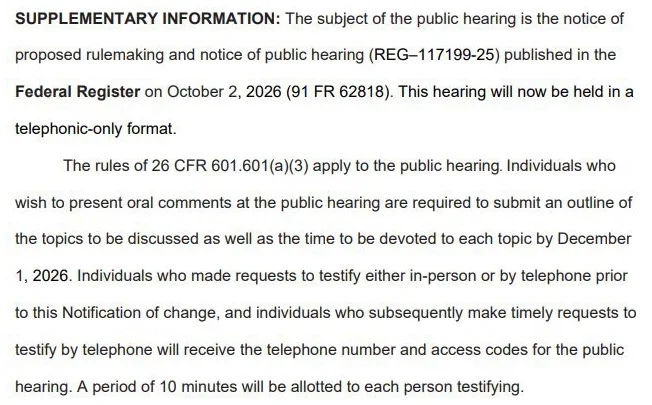
To testify, send the IRS an outline of the topics you want to cover and how much time you would spend on each by Dec. 1. The IRS allots each speaker 10 minutes. For questions about submitting the outline, the notice lists publichearings@irs.gov and 202-317-6901. The agency says it will post the speaker schedule in the rulemaking docket after the outline deadline.
To listen without testifying, email publichearings@irs.gov by 5 p.m. Eastern, or 2 p.m. Pacific, on Dec. 10. Include REG-117199-25 and “ATTEND Hearing Telephonically” in the subject line. The IRS will email the phone number and access code. If you already requested a place in person or by phone, the IRS says you do not need to register again. Requests for disability accommodations are due Dec. 9.
What the credit is worth to donors
Starting Jan. 1, 2027, the IRS says individual taxpayers may be able to claim up to $1,700 for qualified cash donations to listed scholarship organizations. On a joint return, each spouse may be able to claim up to $1,700, for a possible total of $3,400. The contribution has to go to a qualifying organization. Paying a school bill or giving money directly to a student does not meet that requirement. A taxpayer cannot earmark a donation for a specific student. To qualify for the program, an organization must spend at least 90% of its income on scholarships for eligible students.
The credit is nonrefundable, so it can reduce federal income tax owed. Unused credit can generally carry forward for up to five years, subject to the limits in Section 25F. A state tax credit for the same donation reduces the federal credit. For example, a qualifying $1,000 donation that earns a $200 state credit could leave an $800 federal credit before federal tax liability limits. Federal law also bars a federal charitable deduction for a contribution for which the donor receives this federal credit.
Where scholarships will be available
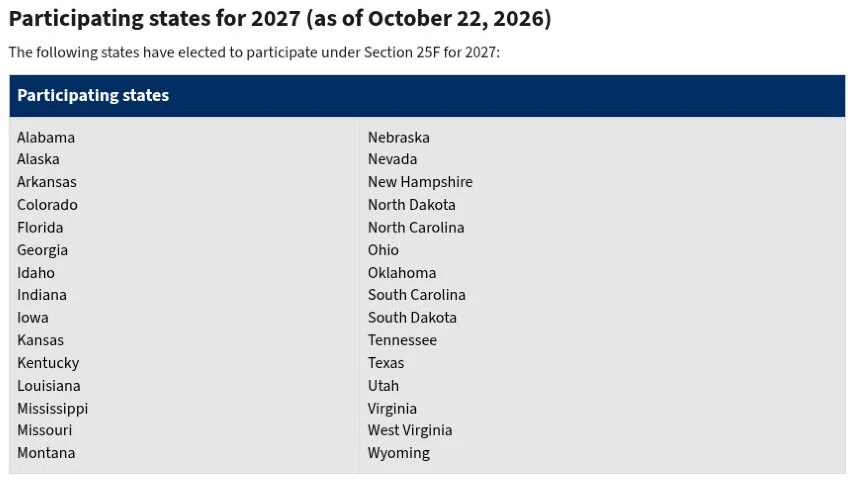
States and the District of Columbia decide whether to participate. The IRS advance election list named 30 states as of Oct. 22. An advance election is the first step. A participating state also has to certify scholarship organizations and submit its list to the IRS. Check the list of approved organizations for the year of the contribution before relying on the federal credit.
Families apply for scholarships through participating organizations. The law limits eligibility to students who can enroll in public elementary or secondary school and whose household income for the calendar year before application was at or below 300% of their area's median gross income. The threshold varies by area. Organizations give priority to returning scholarship recipients and then to eligible siblings of prior recipients. A family's eligibility does not guarantee an award.
Qualifying expenses can include tuition, tutoring, books and other costs defined in federal law. Donors can track state and organization approval through the IRS program page. Families can use those approved lists to find an organization serving their state and check its application dates and award criteria.