
Harry Houdini's library reached well beyond instructions for escaping handcuffs. It held books on witchcraft and stage tricks, pamphlets about mediums, and handwritten records of attempts to communicate with spirits. A century after his death on October 31, 1926, those collections preserve a working life spent learning how people could be persuaded that something impossible had happened.
The centenary offers two ways into that history. The Library of Congress holds thousands of volumes from his bequest, with selected material available online. In Austin, Texas, the Harry Ransom Center's current exhibition, “Houdini's Library,” brings another part of his collecting into public view through January 24, 2027. The show opened August 29 and places his collecting alongside the history of his performances.
The books behind the performances
The Library of Congress received 3,988 volumes from Houdini's collection in 1927. Its holdings are especially strong in 19th- and 20th-century spiritualism, alongside books annotated or inscribed by magicians. Pamphlets cover card tricks, hypnotism and handcuff escapes. More than 100 unannotated scrapbooks contain theater notices and newspaper clippings.
That range placed the practical business of entertaining an audience beside claims about powers beyond the stage. A performer could study a technique, trace its predecessors and collect accounts of people who presented similar effects as supernatural. His shelves preserved both the craft and the arguments around it.
His theatrical collection followed a different route. It was sold after his death to collector Messmore Kendall and later given to the University of Texas. The Ransom Center dates its acquisition to 1958. The books in Washington and the materials in Austin are parts of a dispersed collection, with different histories and different arrangements for seeing them.
A collector who challenged his subjects
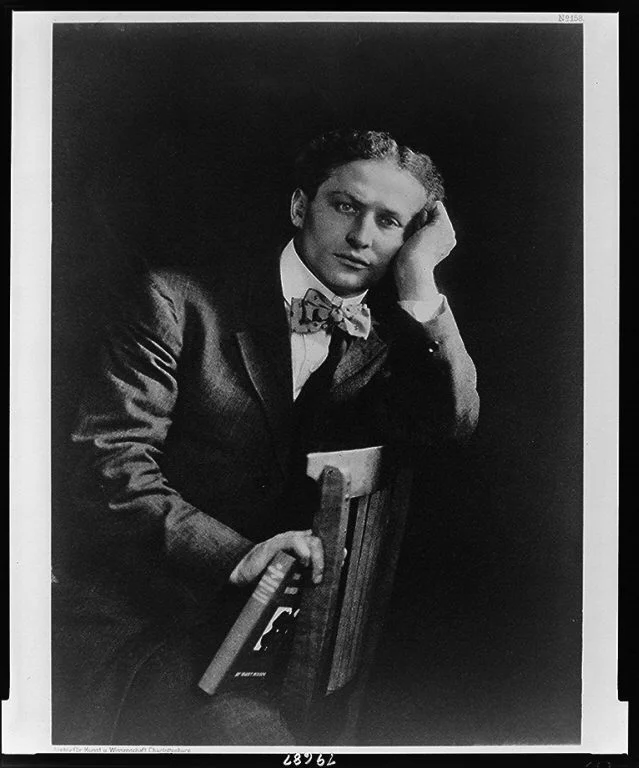
Houdini's collecting could be combative. A 1908 portrait shows him holding The Unmasking of Robert-Houdin, his book attacking the reputation of the French magician whose name he had adopted. The Library's description of the photograph also describes the work as a history of magic. Admiration for predecessors did not prevent an argument with them.
His later campaign against spirit mediums drew on the same appetite for detail. PBS's American Experience biography describes his break with Arthur Conan Doyle over spiritualism and his confrontation with Boston medium Mina Crandon, known as Margery. Houdini took part in the Scientific American investigation and paid to publish an illustrated pamphlet challenging her methods.
The dispute also became part of his entertainment. His 1926 Broadway show combined small illusions and escapes with an exposure of spiritualist techniques. Audiences who came for the escape artist could also see him argue against claims of contact with the dead.
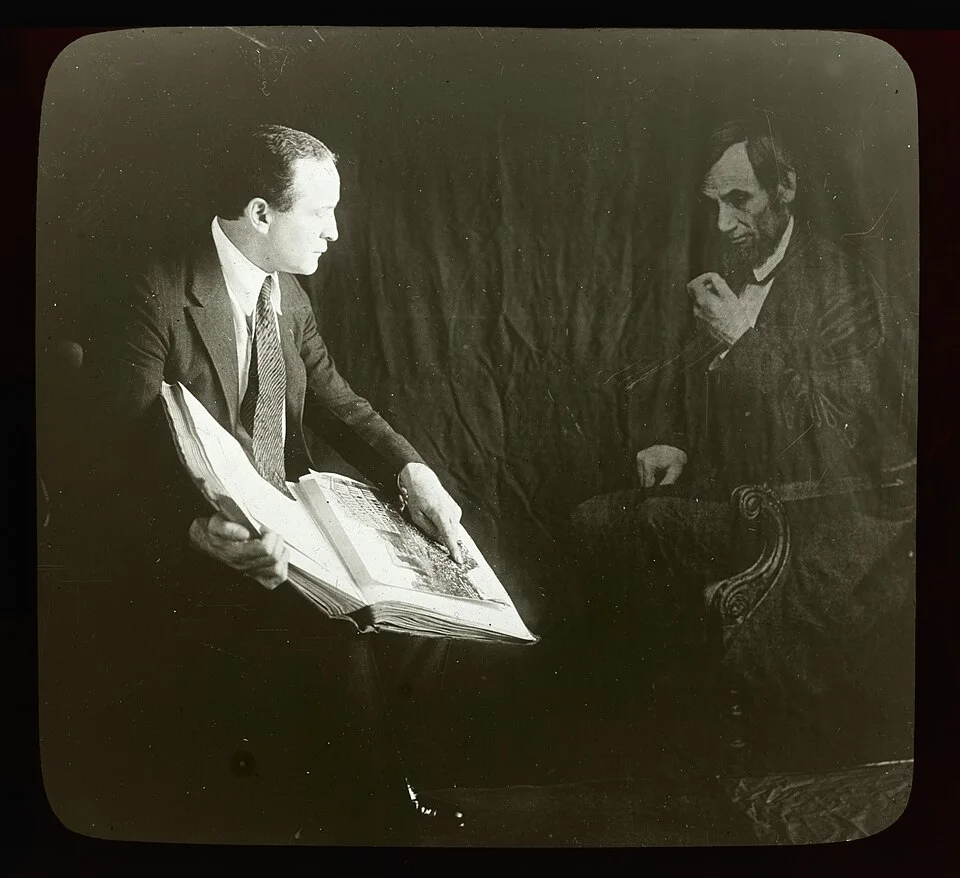
The archive also holds a staged photograph with Abraham Lincoln. Houdini appears beside a translucent Lincoln, an example of how a photograph could manufacture an apparent encounter with a spirit. It documents a demonstration of photographic deception, not a séance or an actual meeting.
The believer's notebooks on the skeptic's shelves
Some of the most distinctive books in Houdini's collection belonged to someone with very different convictions. The Library holds 12 volumes of manuscript material by British spiritualist Frederick Hockley, who recorded experiments with crystals and mirrors.
In a curatorial account of the manuscripts, Amanda Zimmerman describes notes on purported communications with spirits, questions and answers, and astrological and astronomical diagrams. Eleven volumes belong to The Crystal: A Record of Visions and Conferences with the In-Dwellers of the Spirit World; another concerns appearances in mirrors and crystals.
Zimmerman identifies gaps in the surviving sequence and an unresolved question about how Houdini acquired the books. The surviving volumes of The Crystal are numbered 4, 5 and 7 through 15, leaving an incomplete sequence. Their presence on his shelves does not establish that he accepted their claims. They preserve detailed records of practices he investigated, including the writings of a believer.
What visitors can see in Austin
The Ransom Center exhibition, organized by curator Eric Colleary, includes a first edition of Reginald Scot's 1584 The Discoverie of Witchcraft and actor David Garrick's handwritten travel diary. The objects bring both magic and theater history into the exhibition.
The center's finding aid describes correspondence, promotional material, photographs, writings and film records. It also identifies glass lantern slides used in his spiritualism lectures. Some materials have access restrictions, including items damaged after a 1965 fire in the University of Texas tower; an inventory listing is not a promise that every object is on display or available to handle.
Admission to the Ransom Center is free. At 300 West 21st Street in Austin, exhibition galleries normally open Tuesday through Friday from 10 a.m. to 5 p.m. and Saturday and Sunday from noon to 5 p.m. They close Mondays and on holidays including Thanksgiving Day, November 26, and December 23 through 25. The reading room has separate hours and registration requirements. Public exhibition tours are listed at noon Tuesday through Friday and at 1 p.m. and 2 p.m. on weekends.