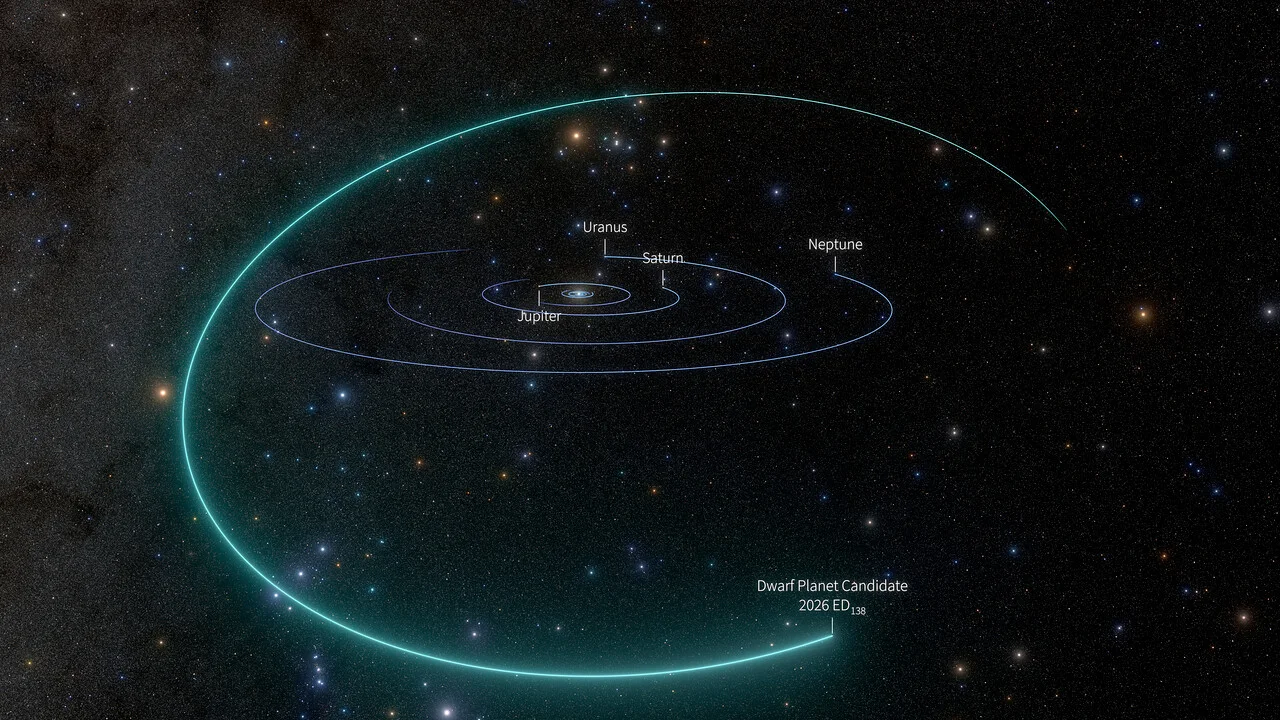
Astronomers have found an icy world beyond Pluto that may be large enough to count as a dwarf planet. The object, provisionally named 2026 ED138, is the first dwarf planet candidate from the new Vera C. Rubin Observatory in Chile, according to the observatory's announcement on Tuesday, October 27. It is about 46 times as far from the sun as Earth is. Pluto's average distance is 40 times.
The team estimates ED138 is between 600 and 1,500 kilometers across (roughly 370 to 930 miles). Astronomers still need infrared observations to pin down its size and confirm that it is round.
How it compares
| Object | Diameter | Status |
|---|---|---|
| Eris | About 2,400 km (1,500 miles) | Dwarf planet |
| Pluto | About 2,377 km (1,477 miles) | Dwarf planet |
| Haumea | About 1,740 km (1,080 miles) at its equator | Dwarf planet |
| Makemake | About 1,430 km (888 miles) | Dwarf planet |
| 2026 ED138 | 600 to 1,500 km (370 to 930 miles), estimated | Candidate |
| Ceres | About 950 km (590 miles) | Dwarf planet |
Sizes for the five recognized dwarf planets come from NASA's dwarf planet pages; Ceres is listed there by its radius of 476 km. At the top of its range, ED138 would be larger than Makemake. At the bottom, it would be smaller than Ceres, the dwarf planet in the asteroid belt.
A dwarf planet orbits the sun and has enough gravity to pull itself into a round shape, but has not cleared other objects out of its orbital path. Icy bodies as big as ED138's estimated size are expected to be round, the Rubin team says. If it is confirmed, it would become the sixth dwarf planet the International Astronomical Union recognizes, after Pluto, Ceres, Eris, Haumea and Makemake.
How Rubin found it
Matthew Holman, a senior astrophysicist at the Center for Astrophysics, Harvard & Smithsonian, spotted ED138 on the evening of October 13. He was running Rubin data from earlier this year through software he wrote with colleague Kevin Napier that sifts through billions of moving-object sightings to find repeat sightings of the same body. The object's brightness and distance suggested it was unusually large.
"My first reaction was one of excited disbelief," Holman said in the release. "Objects like this are very rare, so I immediately started checking whether I or the code had done something wrong."
Mario Jurić, the University of Washington astronomer who leads Rubin's solar system team, then found more images of it. Rubin's telescope recorded ED138 30 times on 20 nights between March 4 and July 11, and older images from the Dark Energy Camera in Chile go back to 2016, giving astronomers more than 10 years of its orbit. The Minor Planet Center, which tracks small bodies for the IAU, announced the discovery in a circular on October 27.
ED138 probably went unnoticed for so long because it sits near the plane of the Milky Way, where millions of background stars crowd the view, the team says. Its orbit sits at an angle of almost 25 degrees to the plane of the planets, which the team says suggests Neptune's gravity pushed it off its original path. Jurić called it "the largest trans-Neptunian object found in about 20 years" in the University of Washington's version of the release.
Rubin began its 10-year Legacy Survey of Space and Time in June 2026 and will keep re-imaging the entire southern sky for a decade. Anyone can follow ED138's orbit in 3D on the observatory's Orbitviewer app.