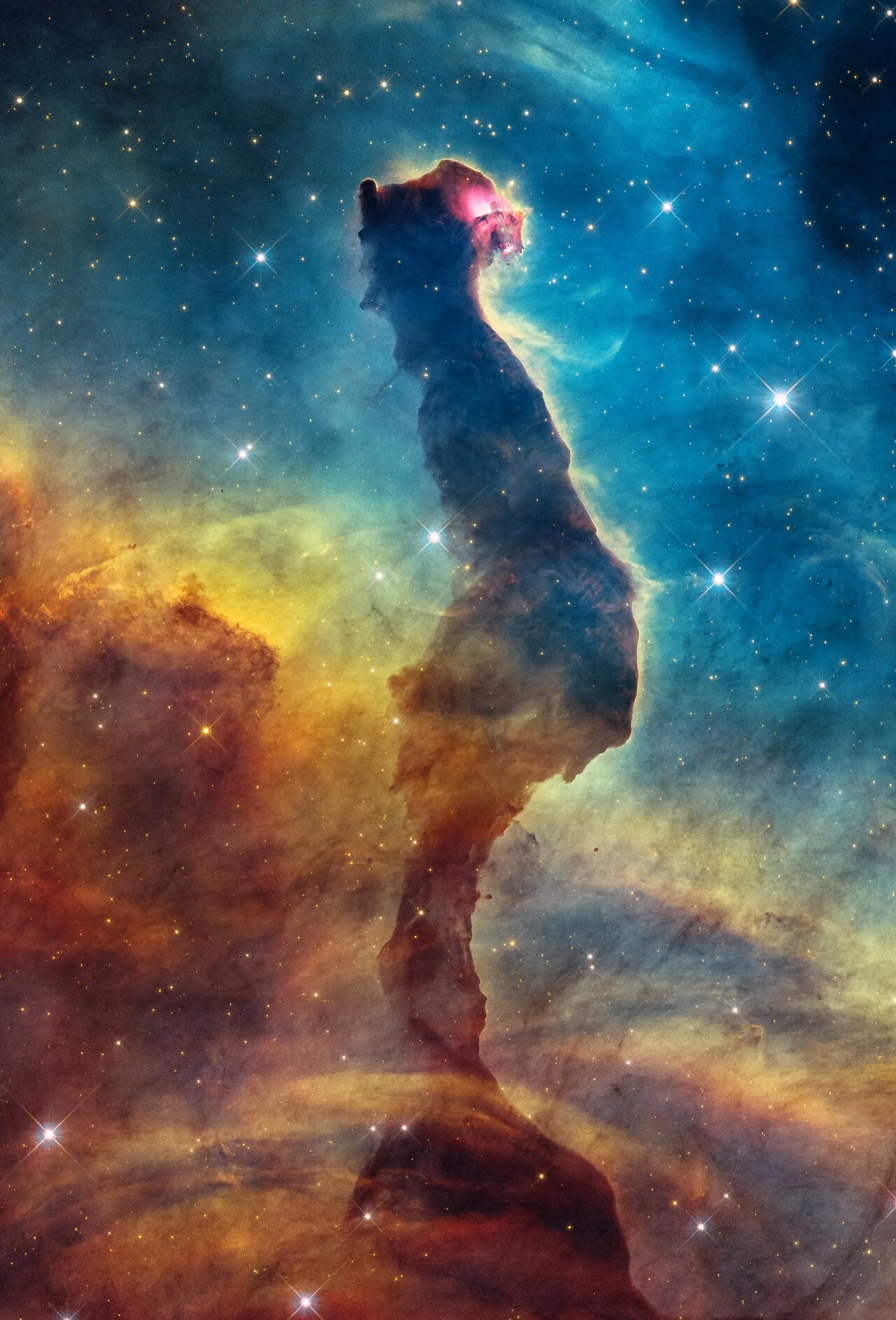
A dark pillar shaped like a cat becomes partly transparent when the James Webb Space Telescope looks at it in infrared light. Hubble and Webb images released October 29 show the Cat's Head Nebula, a small region inside the Carina Nebula about 7,500 light-years from Earth.
The views record different wavelengths of light from the same star-forming scene. Hubble traces an opaque pillar against glowing gas. Webb reveals stars through some of that dust and, at longer wavelengths, emission from the material itself.
What the three views record
In Hubble's visible-light image, the pillar is dark brown, with a bright rim along its right side. The telescope's filters record light from oxygen, hydrogen and sulfur, along with starlight scattered by dust. The rim is consistent with nearby massive stars illuminating and ionizing gas. Their ultraviolet radiation can heat gas and drive it away through a process called photoevaporation.
Webb's Near-Infrared Camera, or NIRCam, makes the pillar more transparent and reveals a dense scattering of stars. Wisps to its left become easier to distinguish, and faint background galaxies are visible. Some stars remain obscured by dust even at these wavelengths.
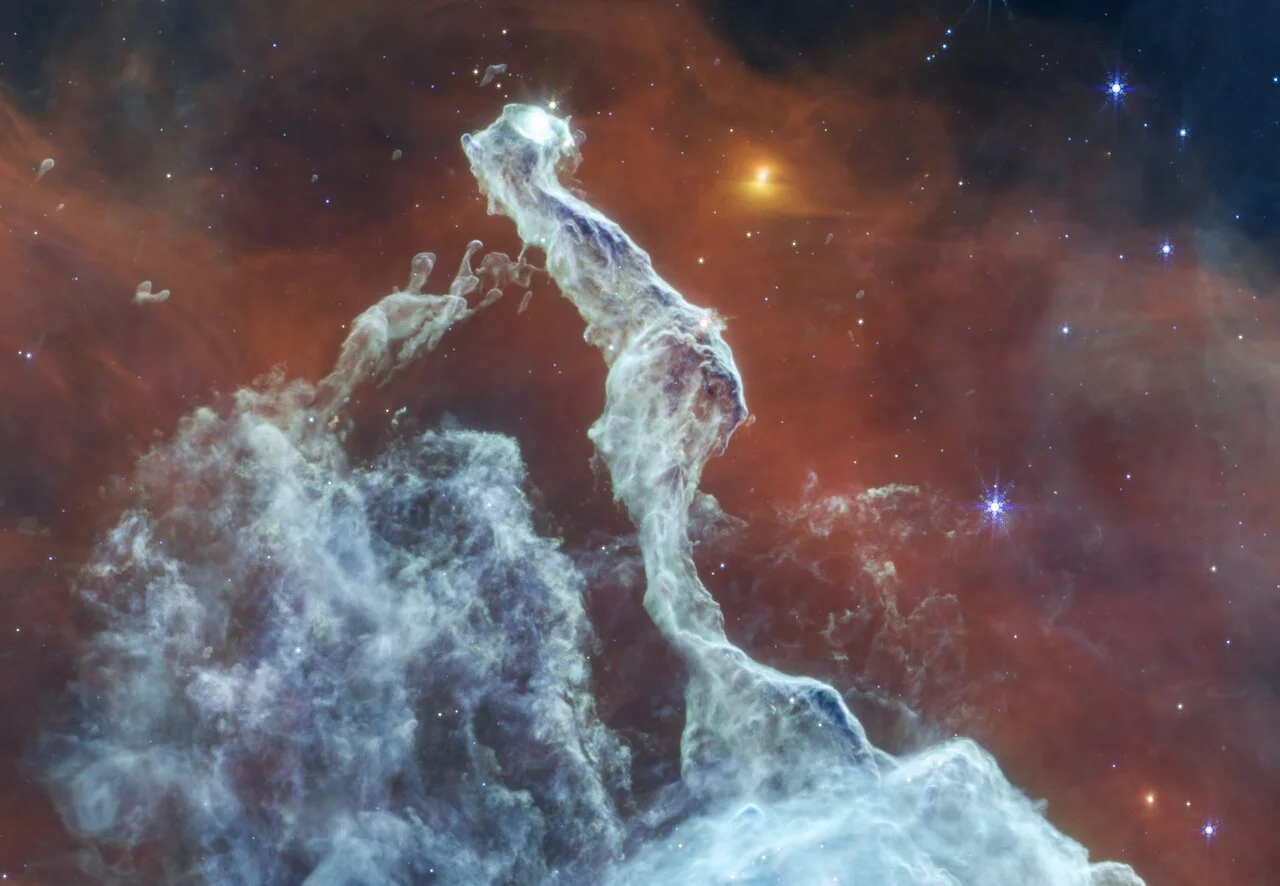
The Mid-Infrared Instrument, or MIRI, shows emission from warm dust and carbon-based molecules excited by starlight. Fine strands and small clumps stand out beside the main pillar. Its colors and brightness vary with the material and local conditions. A bright yellow source appears to the pillar's right against reddish emission.
Why infrared changes the scene
Infrared light lies beyond the red end of the visible spectrum. As NASA explains, its longer wavelengths pass through dust more easily than visible light. That lets an infrared instrument detect light from objects inside dusty clouds that would be difficult to see in an optical image.
Dust also absorbs ultraviolet and visible light and emits infrared radiation. The change between these views therefore involves both seeing through material and detecting light emitted by material.
Hubble can observe some near-infrared light, too. NASA's observatory comparison describes Hubble as optimized for ultraviolet and visible wavelengths, while Webb extends much farther into the infrared. Webb's primary mirror is 6.5 meters across, compared with Hubble's 2.4 meters. The larger mirror helps compensate for the longer wavelengths: NASA says Webb's near-infrared resolution is similar to what Hubble achieves in visible light. More stars in an infrared view do not automatically mean the visible-light image is less sharp.
Recording mid-infrared light also requires unusually cold hardware. MIRI has a dedicated cryocooler that brings its detectors below 7 kelvins, close to absolute zero. Cooling suppresses background noise and allows the detectors to work properly. Webb's sunshield alone cannot get MIRI cold enough.
Where the colors come from
Webb sends back black-and-white exposures, each measuring light admitted through a particular filter. According to ESA's image-processing guide, brighter pixels correspond to more photons reaching the detector during an exposure. Filters isolate wavelength ranges so scientists know which light they are measuring.
To create a color image, processors assign visible colors to exposures from different filters and combine them. Infrared wavelengths are largely invisible to human eyes, so Webb's published colors represent those measurements. Longer wavelengths are conventionally assigned redder colors and shorter wavelengths bluer ones, although the choices vary between images.
The processing also includes aligning exposures and removing artifacts such as cosmic-ray traces or faulty pixels. The resulting colors help distinguish features recorded at different wavelengths. A red area on a screen is not a direct view of red infrared light that a person could see from nearby.
What the bright sources tell us
The bright region at the cat's eye may contain a young star partly embedded in dust. The yellow source to the right in MIRI's view is also likely an infant star. A narrow filament appears to cross the latter source, but the image alone does not establish a physical connection.
ESA/Hubble also provides a 30-second transition video of the telescope views.