NASA will fly the public's names to Saturn's moon Titan on a microchip aboard Dragonfly, the nuclear-powered rotorcraft it plans to launch in 2028. Sign-ups opened Thursday, October 29, and close at 11:59 p.m. Eastern (8:59 p.m. Pacific) on January 15, 2027, according to NASA's announcement.
Everyone who signs up at go.nasa.gov/dragonfly-names also gets a personalized digital boarding pass. The release does not list a fee, and the Dragonfly mission page says the boarding passes are also available in Spanish.
The trip your name would take
| Milestone | Timing |
|---|---|
| Name sign-ups close | Jan. 15, 2027, 11:59 p.m. Eastern |
| Launch | No earlier than July 2028 |
| Arrival at Titan | Late 2034 |
| Planned mission on Titan | About 3.3 years |
The flight to Titan takes about six years, according to NASA, so names added now would arrive in the mid-2030s.
What Dragonfly is
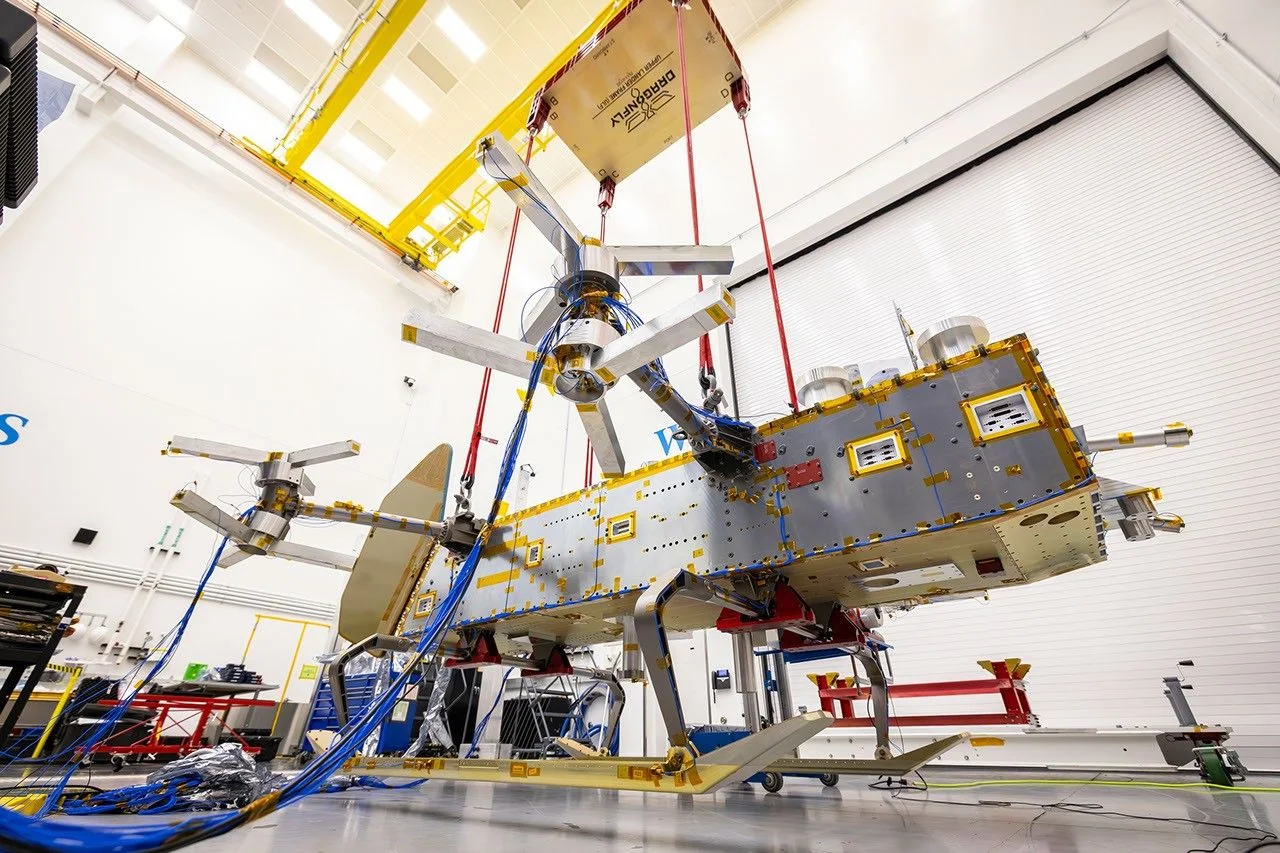
Dragonfly is a drone-like lander about 12.5 feet long and wide and 5.5 feet tall, weighing roughly 2,100 pounds, according to NASA's mission fact sheet. It flies on eight rotors, arranged as four pairs of 53-inch blades, and draws power from a battery and a radioisotope generator that turns heat from decaying nuclear material into electricity.
Titan has a thick atmosphere, and its surface has methane rivers and lakes, dunes and a lot of organic material. Dragonfly will hop between sites miles apart, making about one flight every one to two Titan days, each of which lasts about 16 Earth days. At each stop it will drill samples and analyze them on board. The goal is to study the chemistry that comes before life, not to detect life itself.
"We are excited to bring humanity along for the journey of a lifetime," said Nicky Fox, associate administrator of NASA's Science Mission Directorate.
Johns Hopkins University's Applied Physics Laboratory (APL) in Laurel, Maryland, runs Dragonfly for NASA and is putting the rotorcraft together now. APL planetary scientist Elizabeth Turtle heads the science team. NASA picked the mission in 2019 for its New Frontiers series, where it is the fourth.