The average rate on a new 30-year fixed mortgage rose to 7.28% Thursday, adding about $46 a month to the principal and interest on a $400,000 loan compared with last week's average. A shorter loan carries a lower rate, but a much larger monthly payment.
Freddie Mac's November 19 survey puts the 30-year average up from 7.11% a week earlier and 6.26% a year ago. The 15-year average rose to 6.66% from 6.45%.
It comes a day after October's pending home sales figures showed a 4.7% monthly decline in signed contracts. For a buyer comparing homes, the loan amount after the down payment determines how much that rate change adds to the bill.
What 7.28% means each month
These examples assume a fully amortizing, fixed-rate loan with 360 monthly payments. They show principal and interest only, rounded to the nearest dollar.
| Amount borrowed | At last week's 7.11% | At this week's 7.28% | Monthly increase |
|---|---|---|---|
| $300,000 | $2,018 | $2,053 | $35 |
| $400,000 | $2,691 | $2,737 | $46 |
| $500,000 | $3,364 | $3,421 | $58 |
The changes are calculated before rounding the payments, so subtracting the displayed figures can differ by a dollar. At the year-ago 6.26% average, the $400,000 example would cost about $2,465 a month, roughly $271 less than at this week's rate.
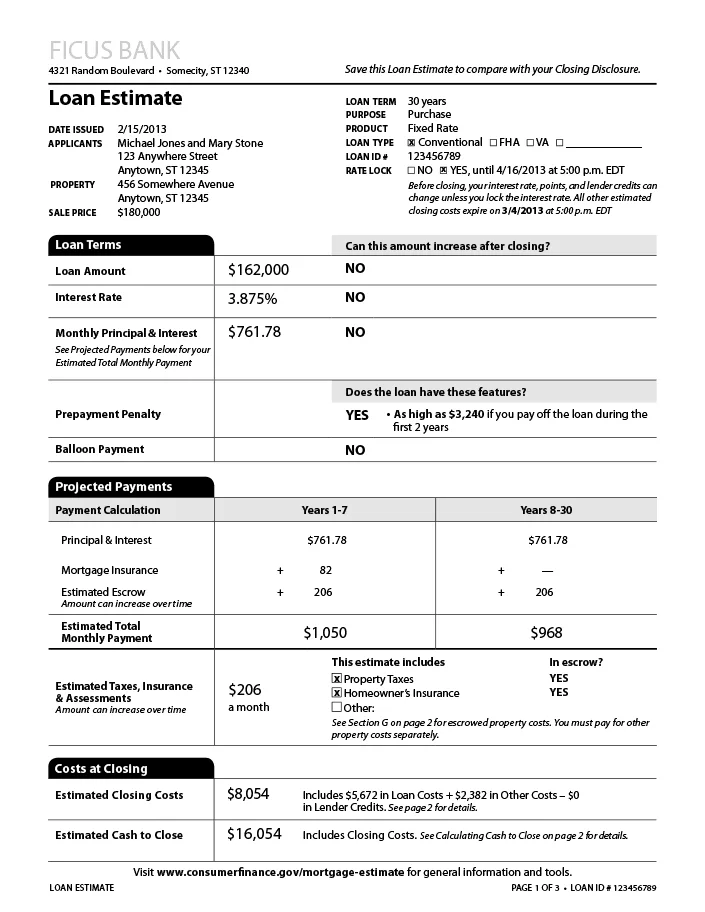
Property taxes, homeowners insurance and any mortgage insurance add to those figures. The CFPB's Loan Estimate explainer shows where the lender separates principal and interest from the estimated total monthly payment. Costs that are not escrowed still have to be paid separately.
The 15-year tradeoff
At 6.66%, a $400,000 loan paid over 15 years has principal and interest of about $3,520 a month. That is approximately $783 more than the 30-year example, despite the lower interest rate.
Paying the balance down faster greatly reduces interest over the full term. With every scheduled payment made and no early payoff, the examples produce about $234,000 in interest over 15 years versus $585,000 over 30 years. Those totals exclude fees and other housing costs.
The shorter term therefore requires more room in the monthly budget. A borrower considering both terms can ask lenders for estimates using the same loan amount, then compare the required payment and upfront cash as well as total interest.
What the survey includes
Freddie Mac averages applications submitted from the prior Thursday through Wednesday. Its borrower profile covers conventional, conforming home-purchase loans with a 20% down payment and good or excellent credit.
A refinance, a smaller down payment or a different credit profile can produce a different offer. The survey also does not report average fees or points, so its interest rate cannot establish the full cost of a particular mortgage.
Compare points, cash and the rate lock
A quoted rate may require an upfront payment to obtain it. Discount points lower the interest rate in exchange for more cash at closing. One point equals 1% of the loan amount, or $4,000 on a $400,000 loan. The reduction in the rate varies by lender and loan.
For example, $4,000 in points that cuts the payment by $50 a month takes 80 months to recover through lower payments, before considering the time value of money. Selling or refinancing sooner would leave part of that upfront cost unrecovered.
Lender credits work in the opposite direction: a higher rate can offset some closing costs. Compare offers with and without those arrangements. The CFPB recommends evaluating costs over the different lengths of time you might keep the loan.
On the Loan Estimate, compare the loan type and term, origination charges, estimated cash to close and annual percentage rate. APR reflects the interest rate plus points, fees and other charges; it is a separate figure.
Finally, check whether the offer is rate-locked and when that lock expires. A lock generally protects the rate through closing if the transaction finishes within its period and the application does not change. Ask what an extension would cost if closing is delayed.