A new AARP Public Policy Institute analysis estimates that Social Security could have paid full benefits through 2059 if the share of the economy subject to its payroll tax had held steady. The estimate describes an alternative history. For people planning retirement today, the federal trustees still project that the retirement and survivors fund will exhaust its reserves in late 2032 under current law.
The research, dated Nov. 10, looks at how much of the country's income comes from earnings subject to the Social Security tax. That gives workers and retirees a way to understand how the program can collect more dollars over time while losing ground relative to the economy that supports it.
Why the payroll tax reaches less of the economy
Social Security collects a 6.2% tax from employees and a matching 6.2% from employers on covered earnings up to an annual limit. The Social Security Administration's 2027 fact sheet puts that limit at $192,300, up from $184,500 in 2026. Those figures apply to Social Security. Medicare has separate payroll tax rules.
For example, an employee earning $200,000 in covered wages from one employer in 2027 would pay $11,922.60 in Social Security tax for the year. That's 6.2% of $192,300. The final $7,700 of wages would fall above the Social Security limit. An employee earning $100,000 would pay $6,200, or 6.2% of every dollar of those wages.
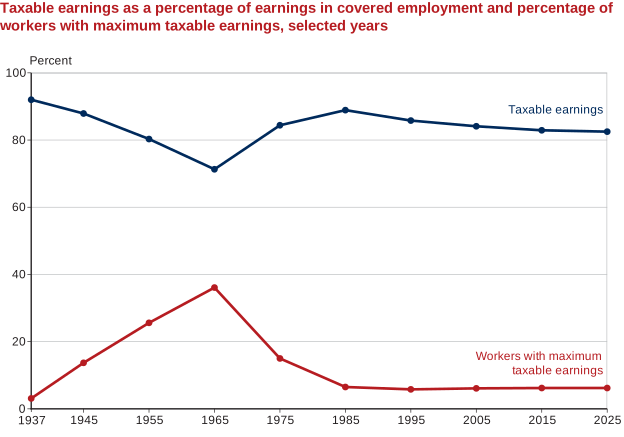
If more wage growth occurs above the limit, more earnings escape the tax even when the limit rises. The agency's 2026 statistical chartbook tracks the share of covered earnings that is taxable and the much smaller share of workers who reach the ceiling. Those measures describe different things. A small share of workers can account for a larger share of wages above the limit.
How AARP arrived at 2059
AARP researcher Richard W. Johnson used Social Security and Bureau of Economic Analysis data to compare earnings subject to the tax with gross domestic product. The institute reports that taxable earnings fell from about 41% of GDP in the mid-1980s to 34% in 2025. The change in that share is separate from the tax rate that appears on a paycheck.
Johnson modeled how Social Security's finances would have looked if payroll tax revenue had kept pace with the economy. In that scenario, the additional revenue would have supported full payments until 2059. The estimate includes decades of hypothetical collections. A change Congress makes now would start from today's reserves and would have its own effect on tax collections and benefits.
The 1980s comparison comes from a period when Congress was dealing with an earlier financing crisis. The 1983 amendments changed several parts of the program, including when workers could claim full retirement benefits. The AARP analysis asks how the revenue base changed in the decades after that legislation.
Which dates matter for benefits now
The 2026 trustees report projects that the Old-Age and Survivors Insurance fund could pay 78% of scheduled benefits from continuing income when its reserves run out in the fourth quarter of 2032. If the retirement and disability funds were treated as one, the trustees estimate reserves would last until the third quarter of 2034, with 83% payable then. The funds are legally separate. Edit USA’s guide to the 2032 shortfall explains why the retirement date and the combined date differ.
The trustees project that the Disability Insurance fund can pay scheduled benefits throughout their 75-year outlook. The earlier exhaustion date applies to the separate fund that pays retirement and survivor benefits.
The projections describe the system's ability to finance scheduled benefits if the law stays as it is. For 2027, the agency's published schedule still calls for a 3.6% cost-of-living adjustment and a $192,300 taxable earnings limit.