NASA confirmed Thursday that Voyager 1 has reached one light-day from Earth, about 16.1 billion miles away. The signal that reached mission controllers also arrived during an unresolved problem: the probe has sent no science or engineering data since November 14.
In its November 19 announcement, NASA said engineers used a radio carrier signal and trajectory calculations to confirm the milestone. Voyager 1 crossed that distance at 2:16 a.m. Pacific on November 18. Its radio signal needed another 24 hours to reach Earth.
The spacecraft is broadcasting, and engineers are still investigating why its measurements and status information are missing.
What the carrier signal tells engineers

A carrier is the radio signal that normally conveys the spacecraft's data to ground antennas. Receiving that signal provides evidence that several parts of Voyager 1 still work.
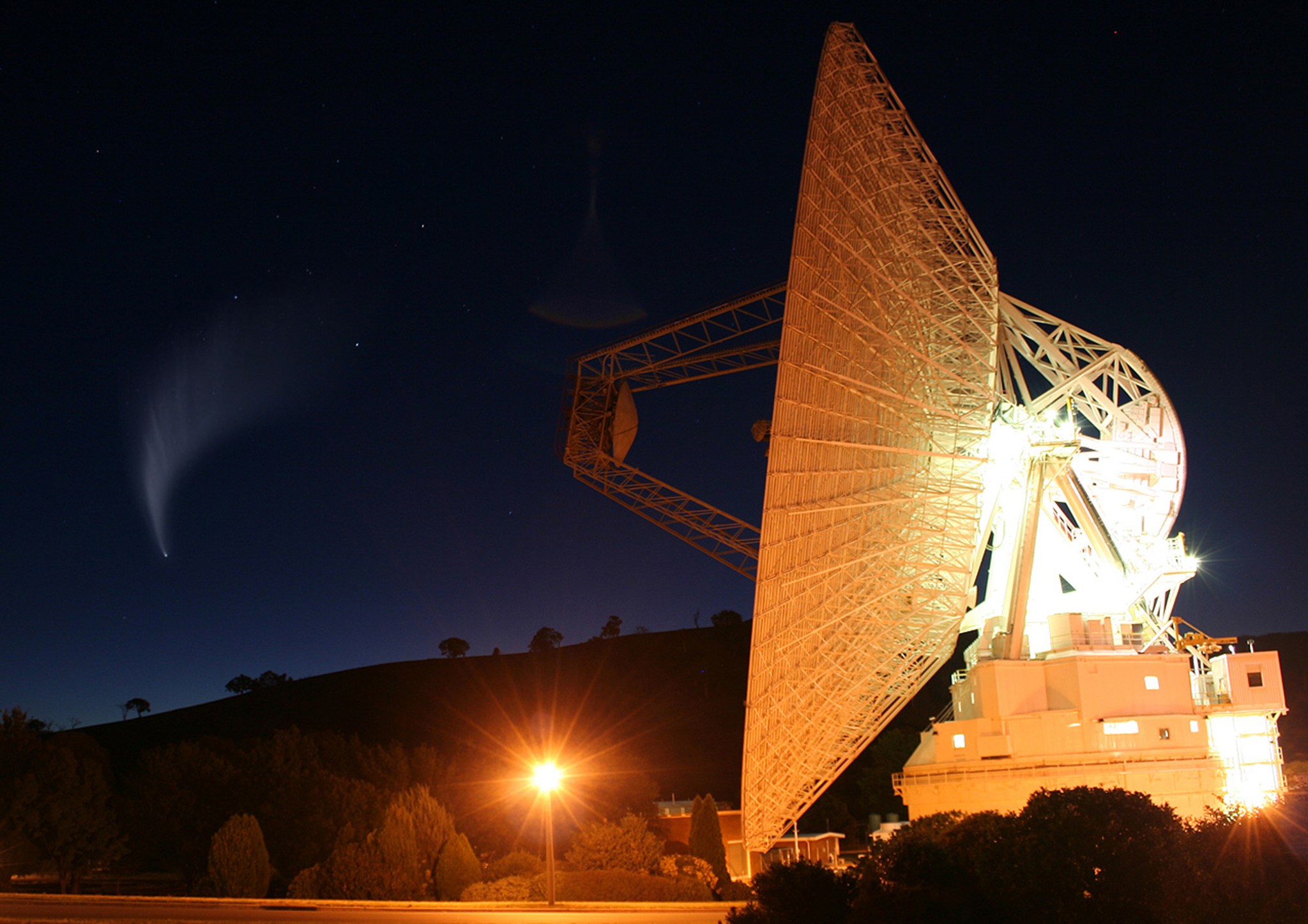
NASA's November 18 engineering update says the signal shows that the attitude-control computer is keeping the spacecraft pointed toward Earth and that the antenna and broadcast equipment are functioning. The team first recognized the data problem on November 14, when a Deep Space Network antenna in Canberra, Australia, locked onto the signal without receiving data.
The missing information points engineers toward the computer that collects data from the spacecraft's subsystems and science instruments and formats it for transmission. NASA has not announced a confirmed cause or a successful repair.
The team is also investigating whether there is a connection to the two-day communications gap in October. During that earlier episode, all contact disappeared, then resumed without a corrective command. NASA says Voyager 1 operated normally afterward until November 14.
A two-day exchange across space
A light-day measures distance, using how far light travels in 24 hours. Radio waves are electromagnetic radiation too, so they face the same travel time. NASA's distance explainer puts one light-day at about 16.095 billion miles.
| Destination from Earth | Approximate one-way signal time |
|---|---|
| Moon, at average distance | 1.3 seconds |
| Mars, depending on orbital positions | 3 to 22 minutes |
| Voyager 1 at the milestone | 24 hours |
At Voyager's distance, a command needs a day to arrive and a reply needs another day to return. That adds up to about 48 hours for a command-and-response exchange, before allowing time to analyze results or prepare another command. NASA says diagnosing the current issue could take weeks or longer.
The Deep Space Network handles communications through antenna complexes near Goldstone, California; Madrid, Spain; and Canberra. Their locations allow one site to take over as Earth's rotation carries a spacecraft below another site's horizon. The network also tracks spacecraft and monitors their health, so losing engineering data limits the information controllers normally use to assess Voyager's systems.
What the earlier recovery can and cannot establish

A previous data failure gives the team experience to draw on. Voyager 1 stopped returning readable science and engineering data on November 14, 2023. Engineers later traced that problem to a failed chip containing part of the flight data subsystem's memory and software.
According to NASA's April 2024 recovery report, the damaged code could not fit in a single available memory location. Engineers divided it into sections, moved those sections elsewhere and adjusted the references so they would work together.
A command sent April 18 restored engineering reports that arrived April 20, 2024. Science-data recovery was still a separate next step at that point. That repair does not establish that the same chip or fault is responsible now.
NASA says the mission listens to Voyager 1 daily and sends commands weekly. For the current problem, engineers continue to investigate the missing data while the carrier signal remains detectable.