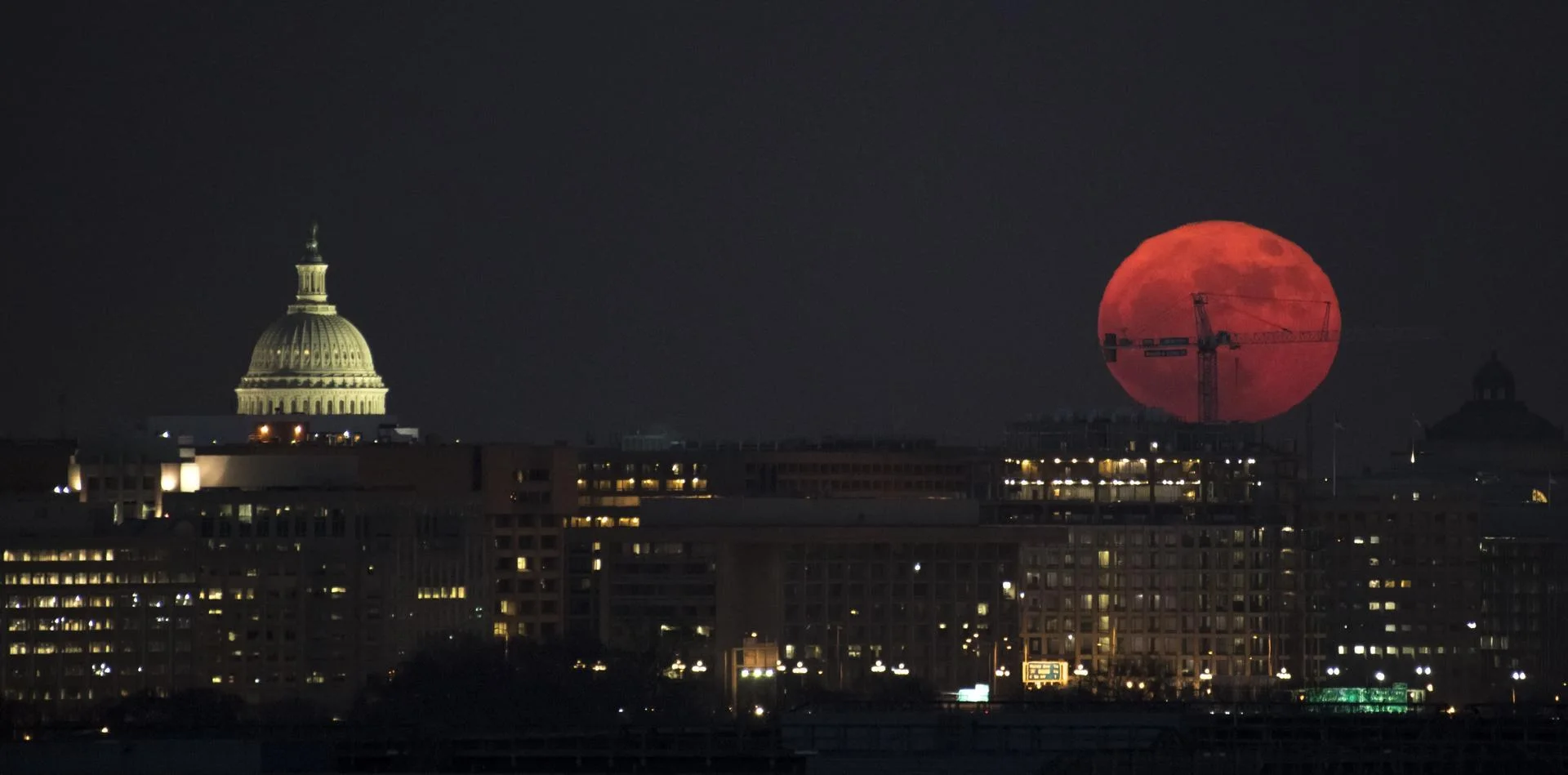
The full Moon on Nov. 24 is a supermoon, the first of three in a row, and NASA says to look east around sunset to catch it rising. Before that, November brings two Taurid meteor showers with the odd fireball, the Leonids before dawn on Nov. 17 and 18, and two mornings when Mars and Jupiter sit almost touching.
None of the sky events needs a telescope. The dates and viewing tips come from NASA's November skywatching guide and the Moon phase times published by the U.S. Naval Observatory.
| Date | What | When and where to look |
|---|---|---|
| Around Nov. 5 | Southern Taurids peak | Any dark sky; about 5 meteors an hour at best |
| Around Nov. 12 | Northern Taurids peak | Same; watch for an occasional bright fireball |
| Nov. 15 and 16 | Mars and Jupiter 1.2 degrees apart | Southeast, before sunrise |
| Nov. 17 and 18 | Leonid meteor shower | Early morning, after the Moon sets |
| Nov. 24 | Full supermoon | East, around sunset |
With counts that low, the Taurids suit a quick look on a clear evening more than a night out. The occasional fireball, a meteor far brighter than the rest, is the reason to look up at all.
Leonids before dawn on Nov. 17 and 18
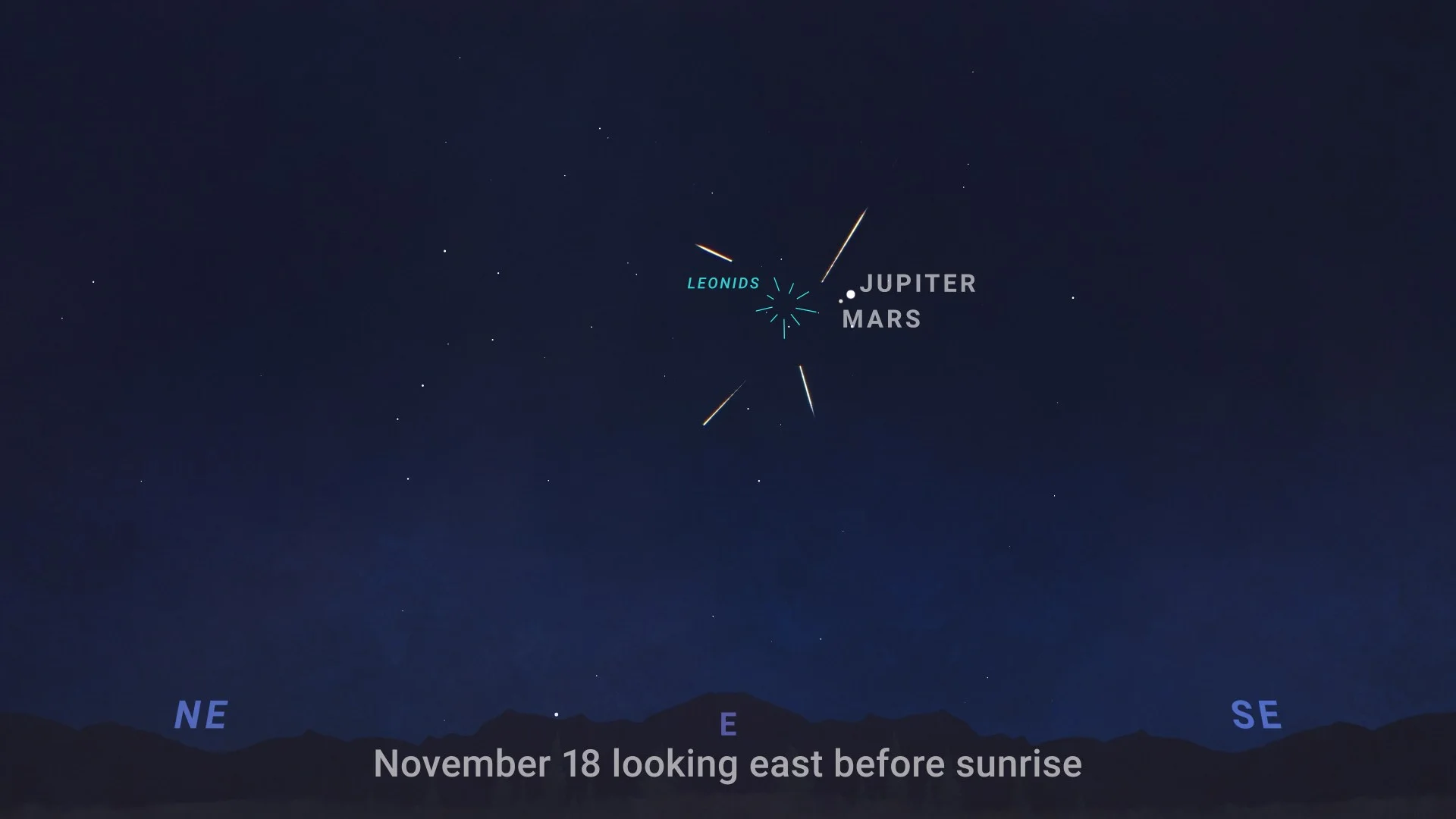
The Leonids are the month's main meteor shower. NASA's best window is the early morning of Nov. 17 and 18, once the Moon has set, when a dark site could show around 15 meteors an hour. Most people will count fewer. Light pollution cuts the number quickly, and the first-quarter Moon (exact at 3:48 a.m. Pacific on Nov. 17, per the Naval Observatory) keeps the evening sky bright until it goes down.
You do not need to find the exact spot the meteors come from. Get away from streetlights, lie back and let your eyes adapt to the dark for 30 minutes or so, then watch a wide stretch of sky. NASA's sky chart for the morning of Nov. 18 shows the shower's starting point high in the east, right next to Jupiter and Mars, so the two planets double as a pointer.
Mars and Jupiter side by side
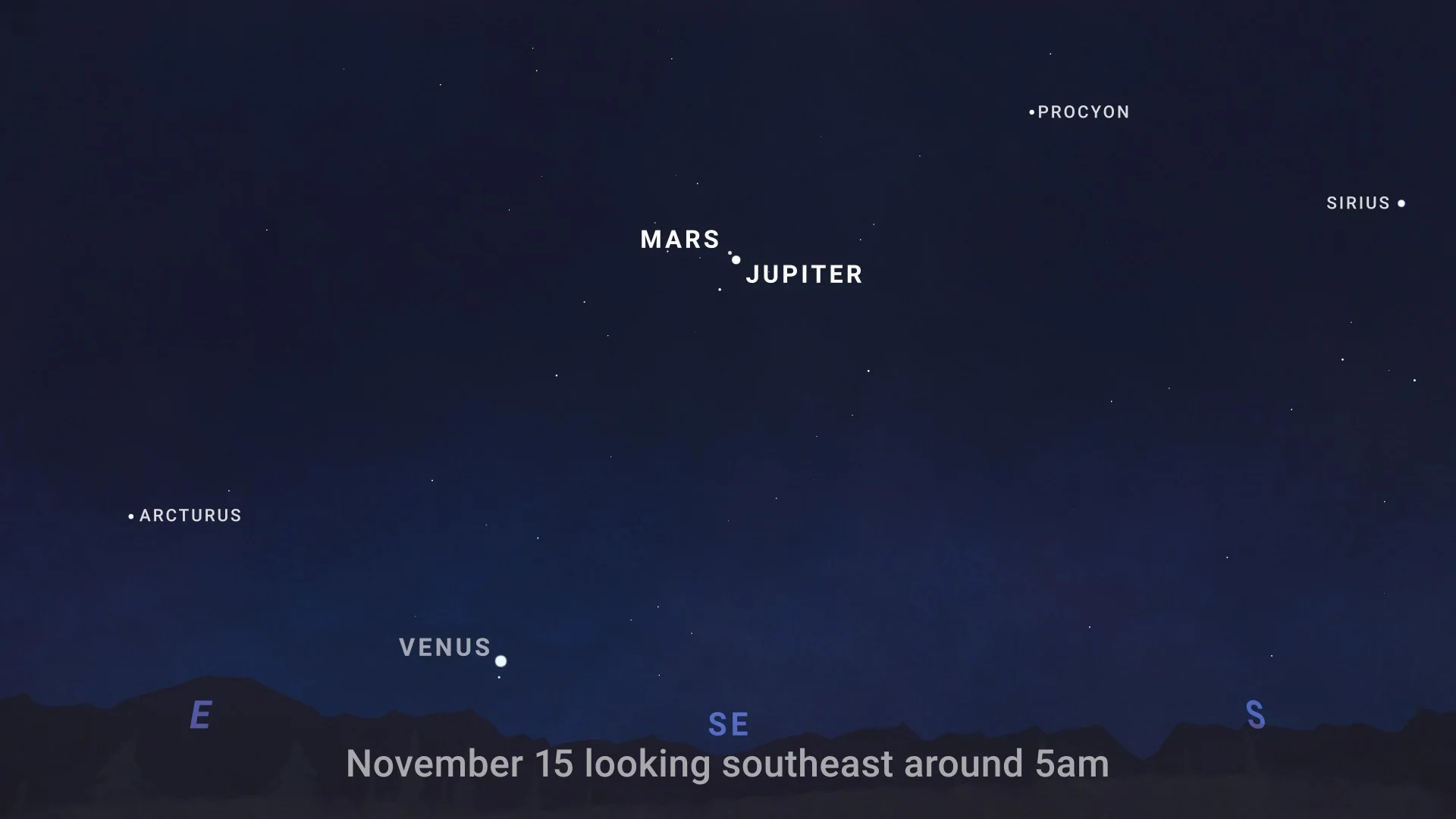
A few mornings earlier, on Nov. 15 and 16, Mars and Jupiter appear about 1.2 degrees apart in the southeast before sunrise. The gap is slightly wider than two full Moons placed side by side. Jupiter is the brighter of the two; Mars is the reddish point next to it. They are nowhere near each other in space. The pairing is a line-of-sight effect, and over several mornings you can watch them close in and then drift apart.
NASA's chart for 5 a.m. on Nov. 15 also shows Venus low in the east-southeast, so early risers get three planets in one view.
The Nov. 24 supermoon
The Moon turns full at 6:53 a.m. Pacific (9:53 a.m. Eastern) on Nov. 24, according to the Naval Observatory, so the evening moonrise is the time to look. Because the Moon's path around Earth is an ellipse, a full Moon near its closest point looks a little larger and brighter than usual, though NASA notes the difference can be hard to see. The Moon also looks huge near the horizon, but that is an optical illusion and happens with every full Moon. November's supermoon starts a run of three, with the next two in December and January.
Voyager 1 reaches one light-day
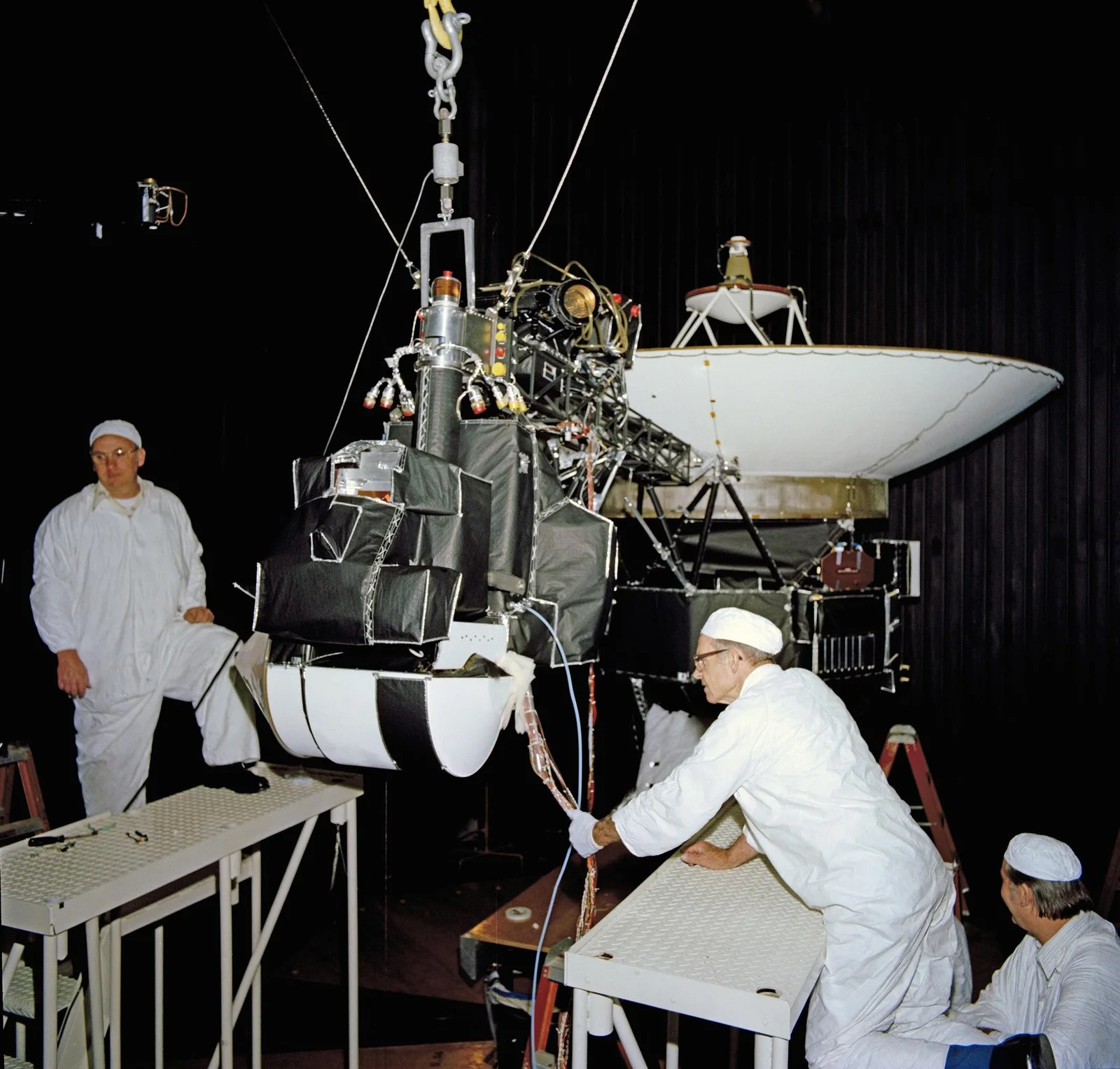
Voyager 1 is about to become the first human-made object one light-day from Earth, so a radio signal takes 24 hours to reach it and another 24 to come back. Edit USA covered the timing in October: the probe crosses that distance early on Nov. 18, Pacific time. NASA is marking it with a "Shine Bright for Voyager's Light-Day" activation on Nov. 17. To face the spacecraft, look toward the constellation Ophiuchus; NASA's chart places it low in the western sky around 5 p.m. on Nov. 17.